



Heating systems
Learn about different options, advantages and disadvantages

|
We all want to have a comfortable environment in our homes and that requires choosing the most suitable heating system for each space. Currently the market provides a wide range of options that is important to know when the time comes to choose the most appropriate equipment.
Different variables must be considered: the regional climate, the type of use (home, office, holiday house, etc. ...); the constructive features and the system’s costs of acquisition and installation, besides its maintenance and energy demands.
Knowing how to analyse the advantages and disadvantages of each system is critical when making a decision, so here are some clarifications below:
1. Central heating
Central heating systems use boilers for heating closed loop water circuits which can feed multiple heat devices, through the distribution pipes into separate house areas.
The major advantage is to adjust the temperature for different rooms.
Central heating boilers can use different power supplies:
Gas boilers
Suitable for homes fitted with natural gas. It presents several advantages: less polluting, easy to install, low maintenance with high durability and the safest of combustion systems. In addition to heating, it also provides warm water at low cost.
Biomass boilers
With the rising cost of diesel fuel, the demand for this system has increased by the strong advantage of low cost consumption.
Like the previous one, this system also allows warming water; however, it requires installing an accumulator and an adaptation kit for this purpose.
Disadvantages focus on maintenance, cleaning and acquisition costs.
Diesel boilers
This system has been increasingly less used, for using a fossil fuel whose price is constantly increasing, which does not mean that in certain situations it cannot be a good choice. However, being highly polluting, it leads us to speculate that its commercialization may end in the future.
In case you have installed this system, you can replace it at any time for a gas burner.
Different heat emitters and distribution systems can be used:
Radiators
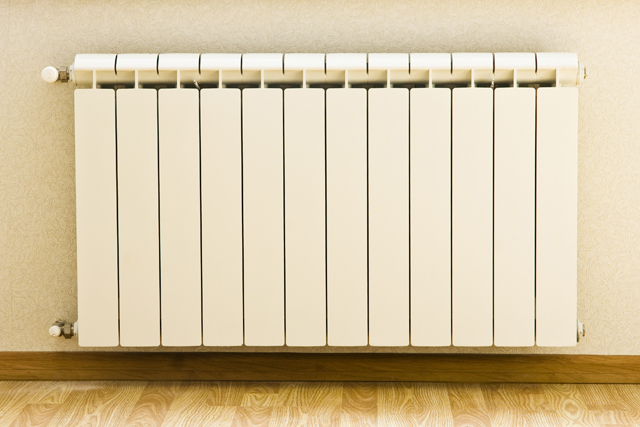
Radiators, made of aluminium or steel, heat the environment through heat exchange between hot water circulating in them and the air inside a room. For optimum performance, they must be placed below the windows.
Radiant floors
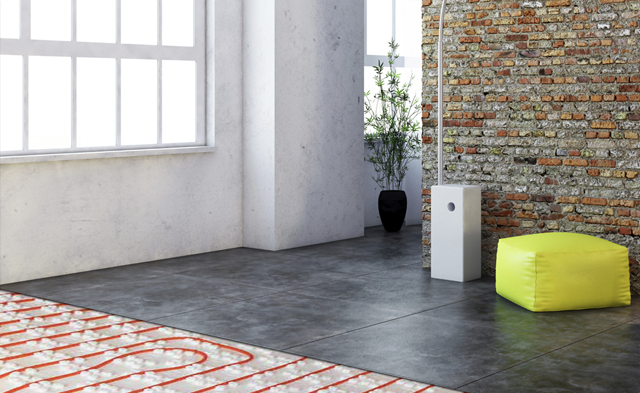
It is one of the most comfortable and healthiest ways to warm up a room. It consists of a flexible tube coil which is placed under the floor, distributing the heat evenly.
Since it does not require high water temperatures it has less heat loss, making it one of the most economical systems regarding energy costs. Another added value, in aesthetic terms, is that it has no visual impact.
Radiant walls
This system is very similar to the above but in this case the heat is dissipated through walls, which have hot water coils inside. The heat is also dissipated evenly, improving energy efficiency, and has no visual impact.
2. Electric systems
These days there are many options for electric heating systems.
The great advantages of these systems are their simple and cost effective installation and a diverse range of options that allow them to adapt easily to spaces. On the other hand they have the major disadvantage of requiring high running costs as a consequence of the constantly rising electricity prices.
Electric radiators and convector heaters
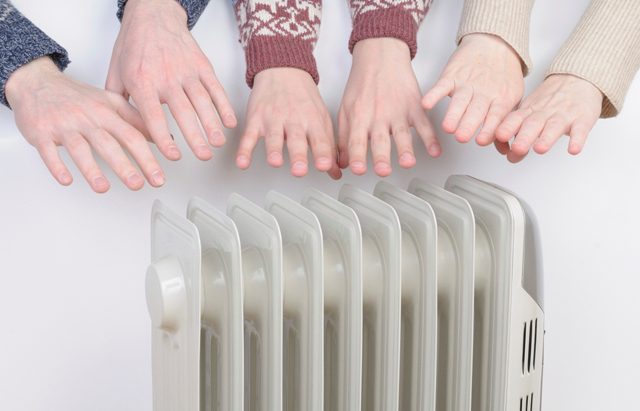
These are independent and mobile devices, and therefore highly versatile. They warm the air through electrical resistors. There is a huge variety of options available, with different shapes and power, but overall their energy efficiency is unsatisfactory. They are often chosen as supplements to other existing heating system, increasing air temperature, or an alternative system when turning the central heating might seem excessive.
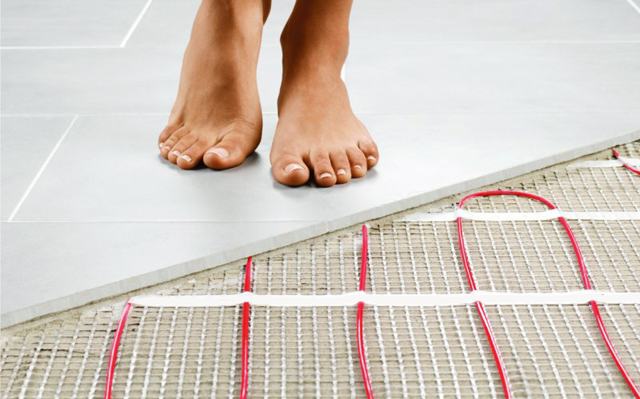
Electric radiant floors or walls
The heat comes through the floor or walls, but in this case the heat emission is performed by passing electric current through a wire or resistance which makes this system very costly.
Heat pump
The heat pump transfers heat from a cold source in a hot source, removing the external thermal energy into a network of air ducts and diffusers and to heat up the water circuits of coils and radiators.
It is a very efficient system, since for each kW of electricity consumed it provides from 3 to 5Kw heat.
And it has even more pros: easy to install, very low maintenance costs, high safety system and fast return on investment.
These systems must be installed from scratch during construction. However, it is possible to replace the existing boiler using the whole pre-installation and radiators.
For better results it is recommended using centralized systems.
Electric storage heaters
These devices store heat in a core of plates, providing a constant room temperature throughout the day. If you opt for these devices, we recommend a bi-hourly rate, making the load only during the night in order to reduce operating costs. The biggest disadvantage may occur in case of insufficient capacity of the device, quickly consuming heated water and requiring waiting until it is recharged.
Air conditioning
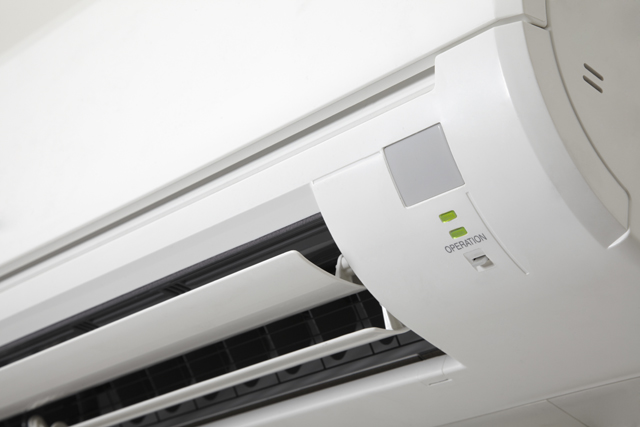
The working principle of this system is to absorb energy from a place and transport it to another, so in most cases you need two devices, one inside and another outside, both interconnected by piping.
There are multiple options:
Standard monoblock units - composed only of one unit placed by the window and generally smaller size, less effective and consume more energy.
Standard portable units – it is equivalent to monoblock but portable.
Split - consisting of two units, one outside and another inside, implying more room to be installed. In terms of noise is quieter, since the noise comes from the outdoor unit. It can be fitted with heat pumps.
Multi-split – it is similar to split, but for each outdoor unit there may be multiple units inside.
When analysing the options, it is important to consult the equipment’s energy label, where you can check the annual energy consumption, coefficient of performance (COP) and energy efficiency ratios (EER), for cold and heat, and associated efficiency measures. Systems with high EER and COP are more efficient.
3. Biomass systems
Biomass is organic matter, animal or vegetable origin, which is a source of renewable energy.
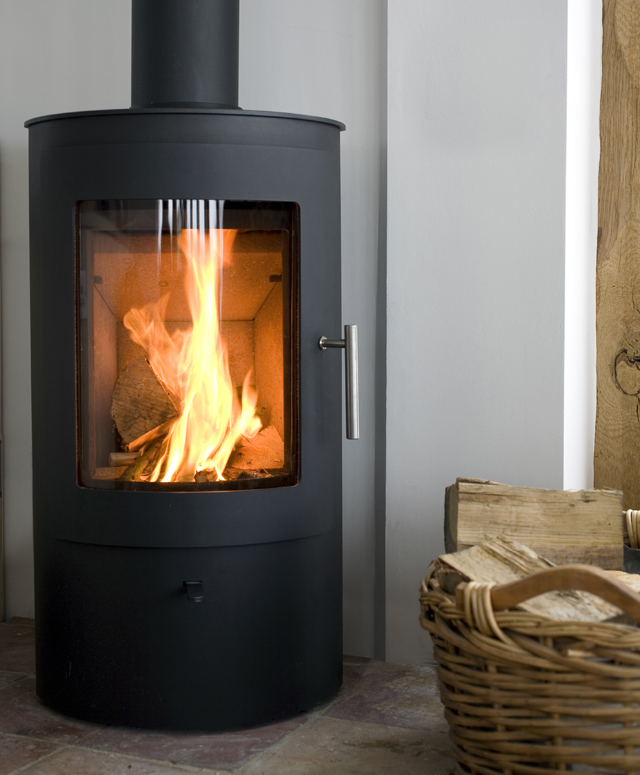
The most traditional biomass combustion systems are fireplaces and stoves, which they have been evolving into more efficient and versatile new devices.
Boilers and heat recovery systems result from such developments, allowing higher energy savings.
In addition to heat the space where they are located, heat recovery systems can be connected to a piping system and distribute some of the heat to other parts of the house, acting as a heat source in a central heating system.
Following these clarifications, we may conclude that the best is to combine different heating systems, radiators and radiant surface, with the installation of a water circuit.
In apartment blocks, the best option is undoubtedly shared central heating, most cost effective and with less energy consumption.
Within electric systems, the more efficient are the heat pumps with centralized operation.
An electric storage heater can also be a good option when combined with a bi-hourly rate.
Typically, single electric heating systems are less energetically cost effective.
Solar thermal energy can be a good addition for heating the house, especially for water circuit systems, however they do not function isolated and often require some support from conventional systems for heating the water.
Consider and plan the heating system for your home and build your comfort with efficiency!