



8 ideas for healthy spaces
Check out the finalists for the Landscape Institute competitionImages via Landscape Institute

|
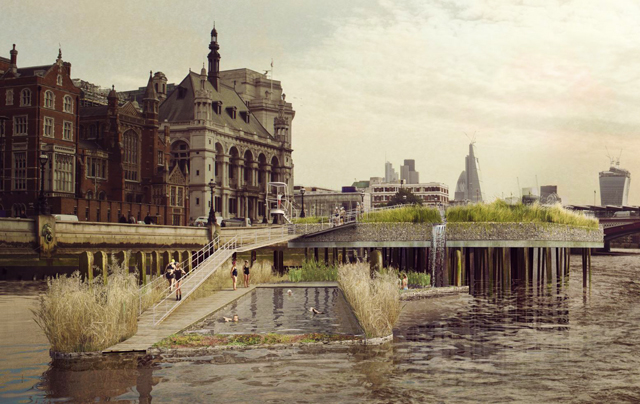
Thames Bath Project | Design by Studio Octopi, JCL Architects and Civic Engineers
How will cities be in the future?
Will they be great grey monoliths made out of glass and concrete?
Or will they have a more human approach?
Contrary to science fiction, the future seems pretty green, more accessible for all those who live in it.
In the year 2030, two thirds of the world's population will live in cities.
As these cities are built and grow in density, better and more excentric solutions arise to improve upon our lifestyles.
We seek sensible approaches to create sustainable life vessels, unlike the stress and polution related to some contemporary cities.
In a contest to find the most imaginative ideas to transform our cities into more healthy places to live in, the Landscape Institute revealed the eight finalists for the "Healthy Places" compitition.
Inaugurated as part of the conference for healthy landscape ideas in the London Garden Museum right after the publishing of the "Landscape Institute's Public Health and Landscape Position Statement", the eight contestants had five minutes to present their ideas in the 30th of April to the audience decide which intervention was victorious.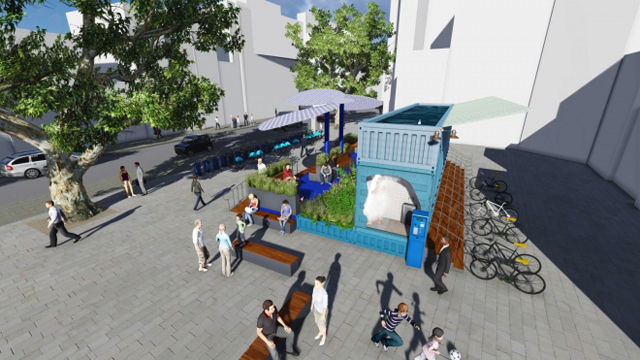
Soapbox | Design by Chris Moss and Earthware Landscape Architects
The audience favorite, the Soapbox, is a place of gathering fed by rain waters and sunlight.
It is said that the biggest obstacle for healthy means of transportation is not the lack of will or equipment, but instead its the lack of shower and clothes changing instalations.
To resolve this issue, a construction out of old shipping containers was proposed - a place of rest for the pedestrian and cycling public.
The modular design comes accompanied by solar pannels as sculptures to shade the intervention and feed the showers and Wi-Fi for those who use this space.
Rain water will be collected in a tank that shall pump water for the public showers.
The waters, after usage, will also be recycled by sprinkling them on the small garden inside the project.
All of this comes to show that sustainability is rewarded by the public eye.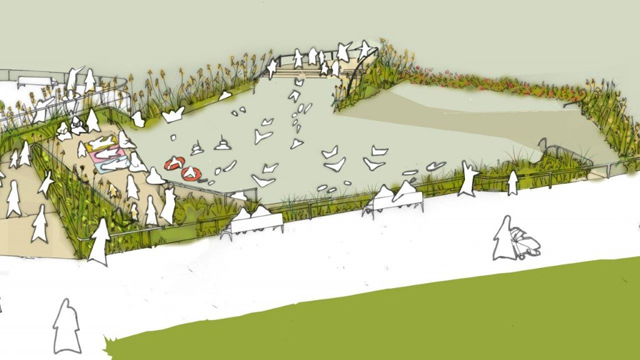
Thames Bath Project | Design by Studio Octopi, JCL Architects and Civic Engineers
The second place for this contest rests in the hands of an unique concept: A swimmable Thames.
The objective of the project was to return one of London's biggest public spaces: the river.
Two pools of filtered water from the river itself, fed by the high tides.
By isolating contaminants, what is proposed here is a unique experience opened to all - reconnecting London's inhabitants to the heart of the city.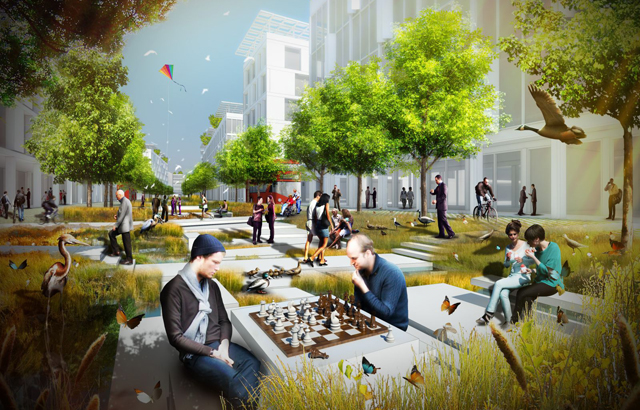
Water Boulevards | Design by Baharash Architecture
The third place went to a solution to the flooding and polution caused by the Royal London Docks.
This green infrastructure proposes to change the docks into a series of public spaces of different heights that recreate the space into a multiplicity of volumes and uses.
This linear aquatic park filters the rain waters through the vegetation from which it is made, giving the ideal conditions to house indiginous fauna and flora to the busy capital.
This breath of fresh air reunites the communities and nature in a grid of well-being that integrates itself into the streets and biosphere, uniting the two.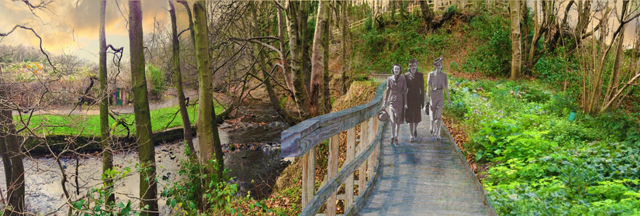
Revitalising the River Don | Design by Alexander Saunders
This elaborate document by Alexander Saunders proposes the integral transformation of the water cannals of the industrialized area of Sheffield into a green corridor built along the Don river.
This transformation would reconstitute this grey zone into a small woodland and waterway, ready to sustain walks and healthy lifestyles for humans and other species.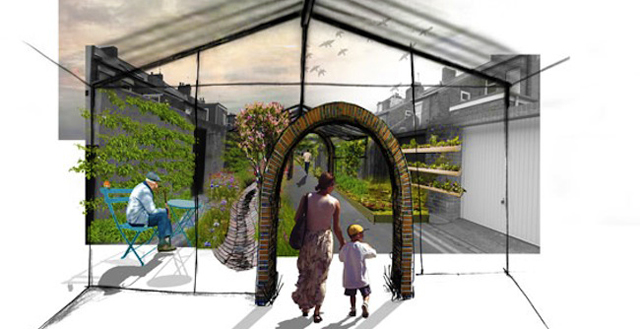
Arcadia Culture | Design by Fairhurst
The Arcadia Culture combines the constructed landscape with green pathways.
Through the years, houses with terraces have not changed. This project will try to spark that change, increasing the well-being and healthy lifestyles of London's inhabitants.
The proposal means to modify the london skyline to include walkways that would unite the different buildings into a network of communitary experiences.
It would be a green and united future, ready to promote culture and agriculture.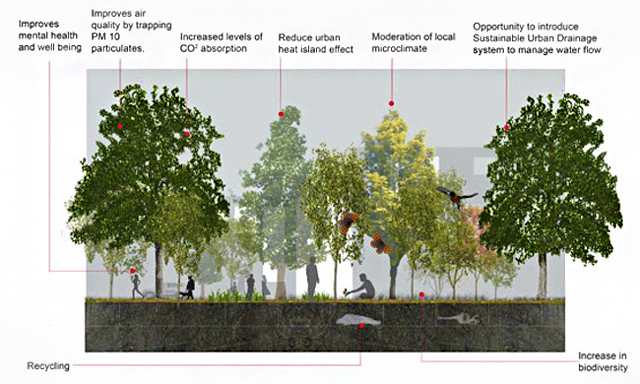
Green Burial Infrastructure | Design by Ann Sharrock and Ian Fisher
Here's a proposal that tries to recreate the morbid side of life into life itself - The Burial Infrastructure proposes to reposition cemeteries from the outskirts of the city into undeveloped vacant spaces across London.
It's an attempt to recreate spaces of death into spaces that serve the living.
The simplicity of the proposal is in the introduction of tree life and activities to mitigate the sadness of these places, along with bigger biodiversity to respect the natural life cycles, to repurpose these noble spaces.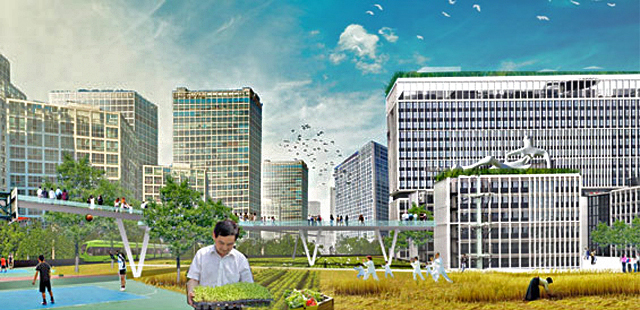
Slow City | Design by Rupert Dehaene-Gold and Atkins Shanghai Landscape Studio
This project is based on the concept of a London without cars.
If the streets would get rid of the metallic creatures, the entire city would be pretty friendly towards the pedestrian public.
Public spaces would increase dramatically and we'd have the chance to cultivate the lands into communitary farms.
Even though this is a vision of beauty and purity, unfortunately it's an utopia.
At least someone still dreams and tries to make the hard questions.
At least someone is showing us what a future built with ideals would be.