


Rebuild by Design
Six projects versus all the hurricanesImages via Rebuild by Design

|
After the devastating effects of Katrina, Sandy and other natural disasters that ruined the lives of those who dwelled on the american coast, many efforts were developed to mitigate the damages.
Many institutions are trying their best to prevent future environmental catastrophes.
Its in this context that the Rebuild by Design competition started by the Hurricane Sandy Rebuilding Task Force, a federal govenment group was founded on the 20th of June, 2013 with the goal of taking action instead of simply rebuilding.
Rebuild by Design is a multi-phase contest that ambitions to rebuild communities with a diminished capacity to cope with the multiple climate issues that they are faced with.
Most of these regions are dependant on turism, so there is a need to keep these areas open to the public but, on the other hand, the safety of it's residents and visitors is paramount.
This is the two-faced problem of these highly dense and economically important coastal areas.
They support a complex system of human developments that is fragile against floods and this complexity mixed with ecologic networks create unpredictable situations that this initative is trying to investigate out of the picture. All of this encourages innovation and care about the different contexts in all of the regions affected.
The chosen places were Connecticut, Maryland, New Jersey, New York and Rhode Island. Each team had to pick a place and a theme: "Coastal Communities, Highly Dense Urban Landscapes, Ecological and Sealife Networks or the Unknown and Unexpected".
A hundred and forty eight participants from around the world applied for the competition. Of those, ten multidisciplinary teams from many esteemed architecture offices stood out. One year of research and drawing amongst them and the communities involved later, six winners were chosen.
Each one of the teams presented it's proposal to the public in the Liberty Science Center in New Jersey.
After the project's approval, the proposals are to be implemented with the funds of the Community Development Block Grant - Disaster Recovery.
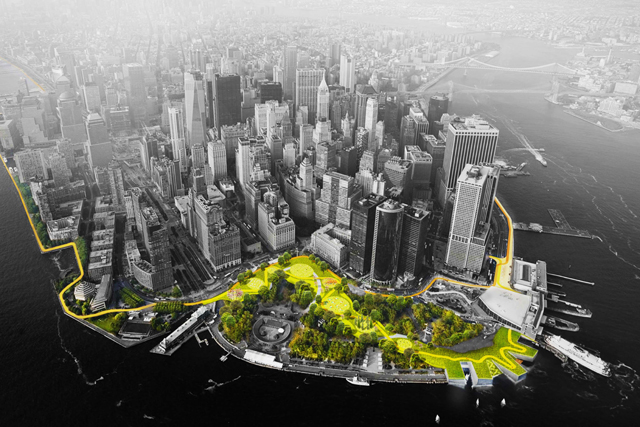
BIG U - New York, New York
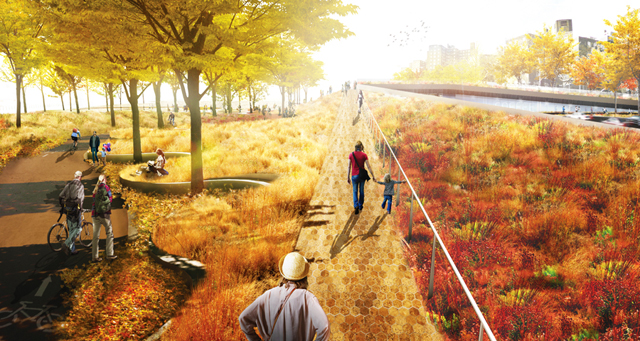
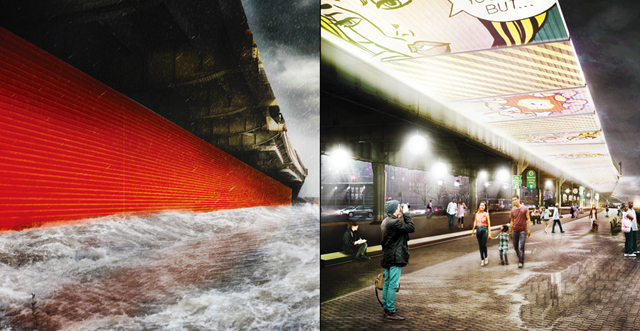
Bjarke Ingels strikes again with another unique project, this time in the Big Apple!
It spans over four localized interventions to protect the dense city from flooding whilst creating new social and environmental assets for the community.
It starts out with a park with various natural pathways filled with trees and shrubs capable of resisting salty waters then onto a set of sliding walls decorated by local artists that activate when needed and help to iluminate when they aren't.
A maritime museum is also in the works to help teach people about the effects and causes of flooding and to top it all off, an elevated pathway along the financial district featuring different views and leisure spots will also be made.
Hunts Point Lifelines - Hunts Point, Bronx, New York
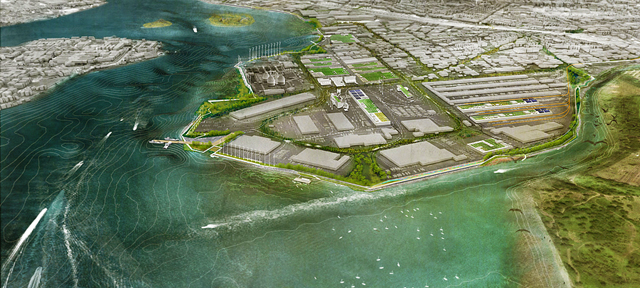
After the four themes were presented, Penn Design and OLIN replied with four unique proposals.
Hunts Point is a center for food production for over 22 million people, creating 20 thousand jobs and 5 billion dollars anually. The objective of this project is the safeguard of these assets through their amplification.
A workable coastal front was proposed to help the community by having it build upon the project and it's lessons, respecting the region's environmental characteristics throughout four steps:
- The Flood Protection Leevee Lab - A protection against floods that recreates leisure and work platforms whilst bringing new legislation for industrialized coastal regions.
- The Livelihoods - New construction techniques applied by the community in the fight against harsh climate changes created on the individual level, promoting a new sustainable conscience in the region.
- The Maritime Emergency Supply Lines - A new port that starts a series of waterways that work as emergency supply lines for dire times and, alternatively, it'll be a fish transport port for daily use.
- The Cleanways - A series of pedestrian walkways, roadways and refridgeration centers for the local food industry, all low cost and carbon emission efficient.
Resist, Delay, Store, Discharge - Hoboken, New Jersey
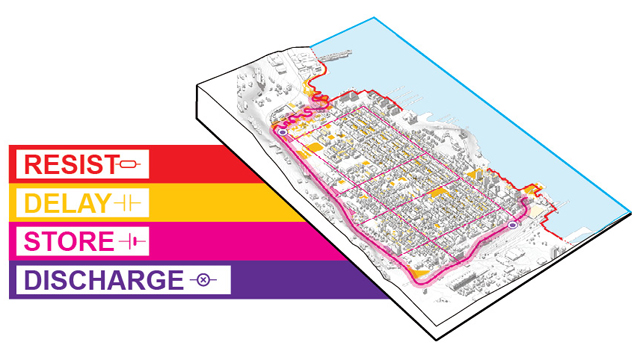
The cities of Jersey, Hoboken and weehawken are highly susceptible to flash floods.
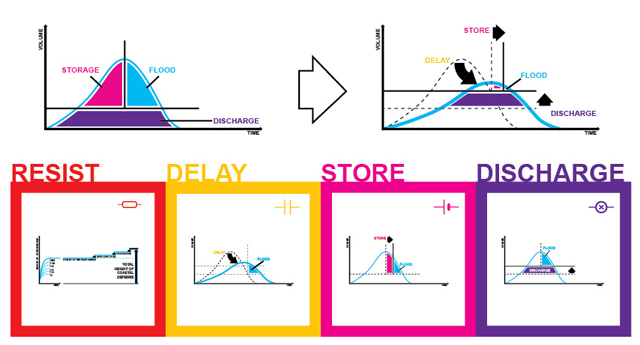
OMA offices propose a detailed intervention that respects the urban density and complexity of the place and transform those characteristics into energetic standpoints to defend the area from the flood waters and reuse them for future use.
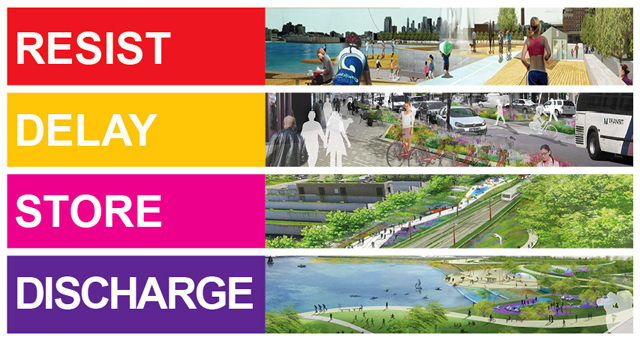
- Resist - A coastal defensive infrastructure.
- Delay - Legal recommendations for the redrawing of the urban fabric to slow down the harmful rain water effects.
- Store - A circuit of natural infrastructures that accumulates flood waters for its posterior usage or draining.
- Discharge - A water pump system to remove excess waters from the system.
New Meadowlands - The Meadowlands, New Jersey
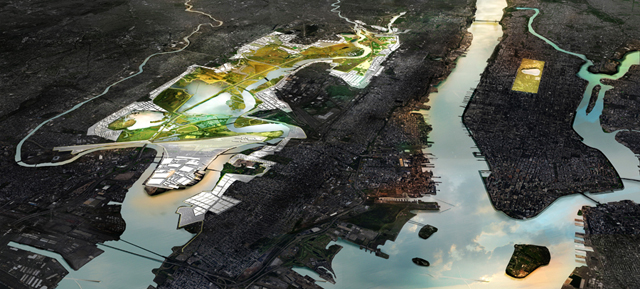
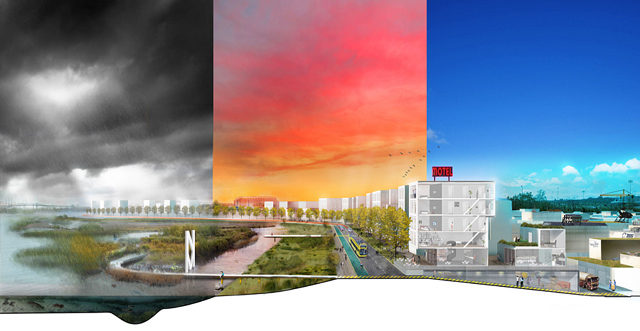
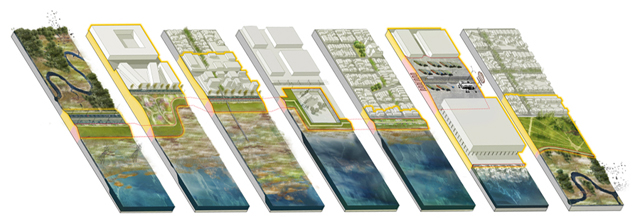
Here's a project that articulates the vision to protect and connect the coastal region of New Jersey with the metropolitan area of New York, integrating transports, ecological assets and the development of the sea basin of the Meadowlands.
This natural reserve will be transformed into a flood dampening area whilst openning it to the public through a detailed system of views and pathways. MIT CAU, ZUS and URBANISTEN propose a bus lane, some public spaces, leisure areas and different points of access into the swamp areas whilst increasing the density of the urban settling of the area, giving it increased social and economic value.
Living Breakwaters - Staten Island, New York
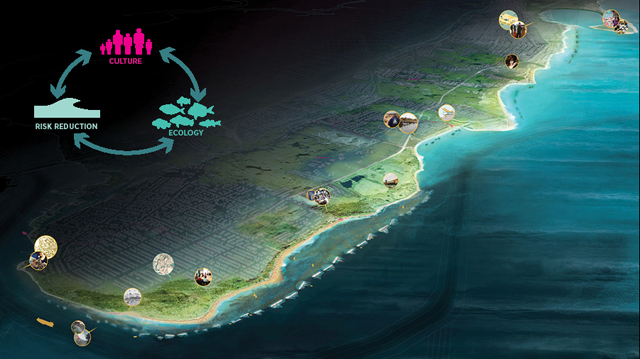
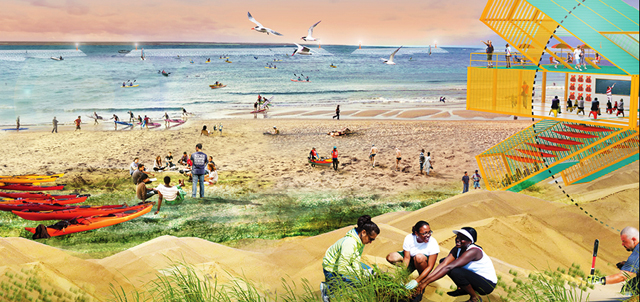
The SPACE landscape office made a project that reduces environmental hazards, revives sea life whilst promoting education in the coastal area, inspiring a new generation to safeguard it's natural and human resources next to the sea.
Staten Island is easily eroded by wind and waters. Instead of creating a wall around it to divide people and the sea, the project seeks to create a barrier in the sea that decreases the harmful effects of extreme climates and, at the same time, works as a habitat for sea creatures.
Living with the Bay
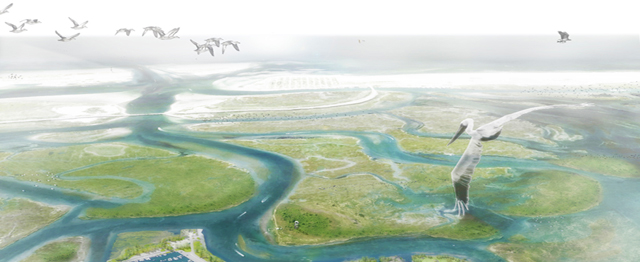
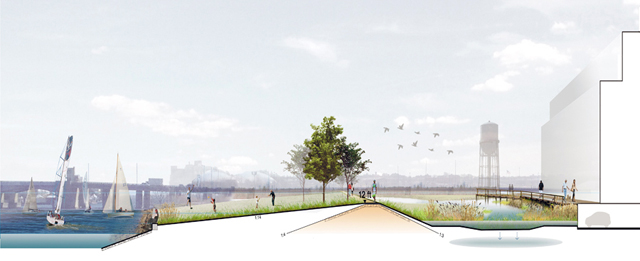
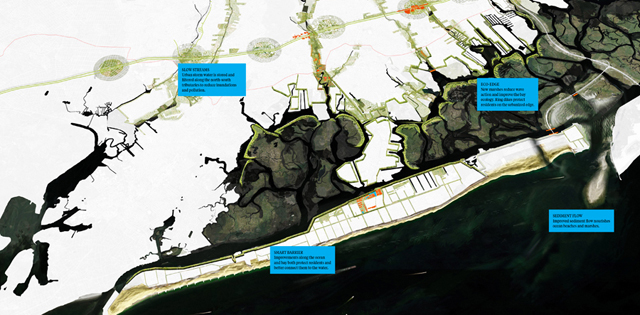
In a region with multiple possibilities for a natural disaster, where there is no one solution, the Interboro Partners propose varied options for intervening simultaneously in the region to combat the floods.
The barrier-island was key to these solutions - several water storage, cleaning and reuse technologies were applied to it.
Meanwhile, the swamp areas were openned to the public for new leisure activities and the rivers were transformed into green corridors as new centers for urban development.
Strategies like these protect inhabitants from extreme climate conditions whilst preventing future reconstruction efforts like this one and increasing the life standards of the region.
Even though there isnt a single solution for all the problems, these projects show us that complexity is managable and all problems can be solved with the help of the community, some legislation and a big dose of creativity.