


Game of Thrones Architecture, Part III
An inquisitive look at the exotic continent of Essos

|
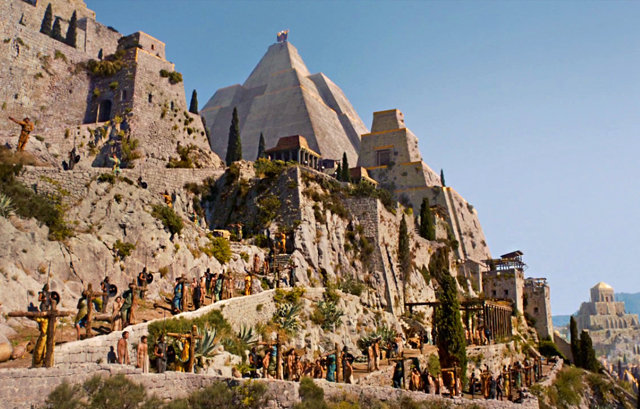
Meereen, during the punishment of the Masters | Image via Incantesimando
A week without our prime fantasy world can have devastating effects, but for those who miss our favorite television drama the most, we have something here to calm your need for the world of fire and ice.
It's the third edition of our travels through the world of Game of Thrones and, as such, we have three cities to study:
Meereen, Astapor and Yunkai, the pearls of Slaver's Bay, to the South of the vast continent of Essos!
Even though we only have the unstoppable conquests of Daenerys to show us this exotic continent to the East of Westeros, these adventures ripe with social justice introduce us to a very different reality from the wars for the Iron Throne.
It is here that we find the endless deserts, untamable forests, the most savage warriors, the longest family buisnesses, an unequal variety of ethnicities and spices to acompany them!
But before we explore the whole continent, let us focus on the current location of our Mother of Dragons - Slaver's Bay.
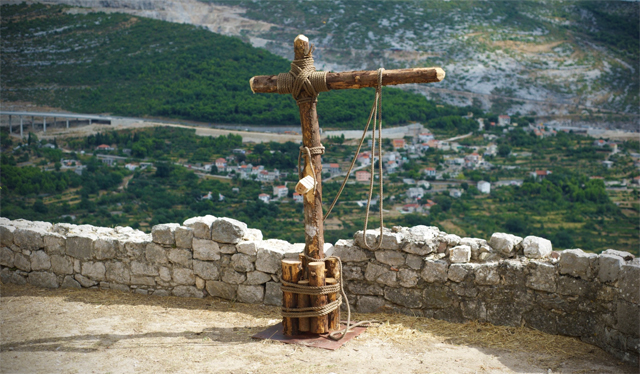
The horrors of Meereen | Image via Imgur
Slaver's Bay was built from the ruins of the old Ghiscari Empire when the Valyrian Freehold, the unstoppable kingdom that ruled the world with it's dragons for centuries, saw that there was some value in keeping the slaving buisness alive.
As cruel as these activities were, they remained longer than any other empire that came before it, until the day Daenerys came to opose the unopposable.
The three wealthiest cities of the area maintained the traditions of Ghis, including it's sigil - the Harpy (half-woman, half-bird, all beast)
This symbol is present in the top most parts of all the piramids and in the flags of the great slaving Masters, to instil fear in the hearts of the slaves that flood their streets.
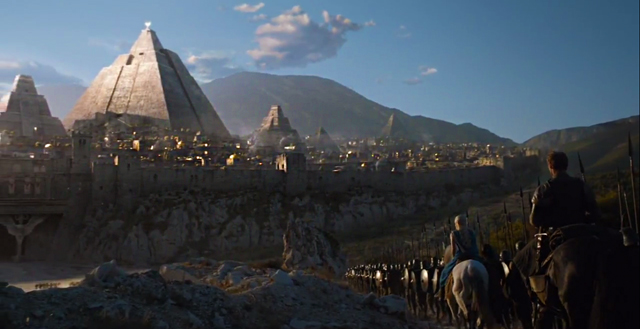
Daenerys marching towards Meereen | Image via HBO
Let us start by reviewing the biggest of the piramids and it's city, the biggest of the bay, Meereen.
It is governed by the Great Masters, the rich leaders of the slaving families.
It is built from multicolored bricks and the rock mined from the mountains surrounding it.
This is the limit of the grotesque Ghiscari civilization and the unrelenting desert - The Red Waste.
It's the city closest to the nomad Khals and their conquering tribes that stop by to get their bribes.
The great walls that surround it are high, but not as high as the 250 meter high piramid at it's center, decorated with a giant bronze harpy statue at it's peak.
This piramid is the current house for Daenerys Targaryen, from which she may watch over the remainder of the city, like the two other superstructures - the Temple of the Graces and the Fighting Pits.
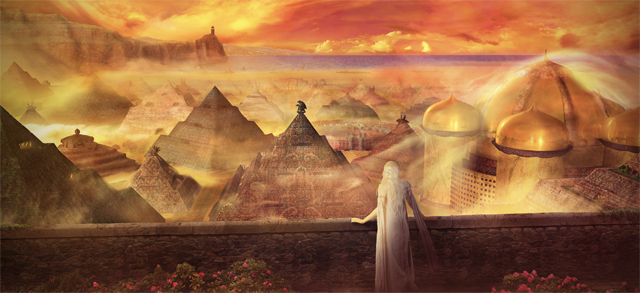
Meereen, as seen by Daenerys | Image via Deviant Art
The Temple of the Graces is a building with it's rooftops made in gold, reminiscent of the Jeruselem-based mosques of our world. It's a house for the priestesses of Meereen, to the West of the Great Piramid.
The Fighting Pits are colossal circular arenas made out of brick, ready for the most epic combats and horrors, like the Roman Colosseum was during it's prime. The biggest and most luxurious of these is the Darnak's Pit, the one with two big bronze statues fighting to the death at it's entrance.
Even though the current events of the series are focused on the politics and leadership of this city, alot remains to be seen in the different corners of Meereen. Who wouldn't like to see a couple of visceral fights in the Pits or an appearance from the dragons, soaring between the skies of this history-filled city of this mystical corner of the world?
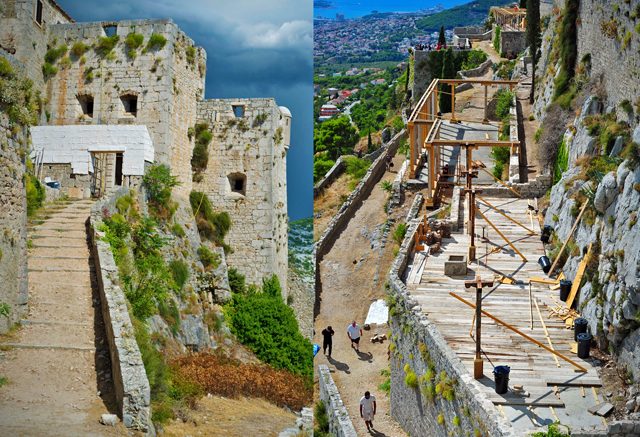
The assembly of the filming sets for Meereen | Image via Imgur
For the filming of this grand fortified city, the medieval Fortress of Klis in the southern part of Croacia was used.
Near Split, this fortification was built by the Dalmatae tribe as a seat for the trone of many croatian kings up until the Ottoman wars in the region.
It's strategic location between the mountains of Mosor and Kozjak were used as a defense against any invasions at the kingdom's borders and, in this case, as a captivating backdrop for the political settings in this broadcasted drama.
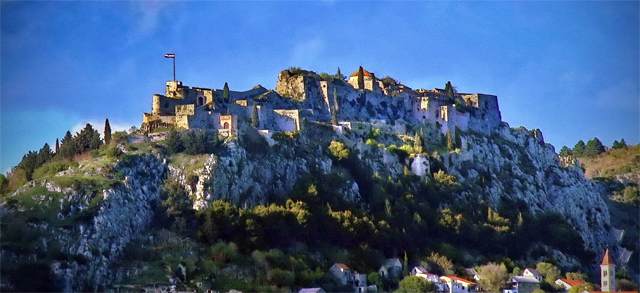
The Fortress of Klis | Image via Wikipedia
Although it's importance is not only strategic, it is also historical.
This building is one of the last remaining vestiges of defensive Dalmatian architecture, developed across the mountain top in three distinct rectangular defensive layers embedded on the rock that supports them.
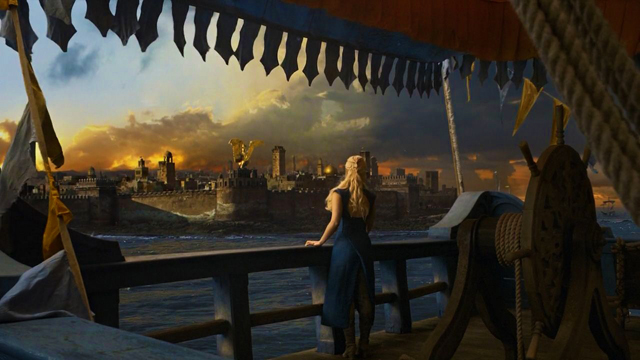
Daenerys' view of Astapor | Image via HBO
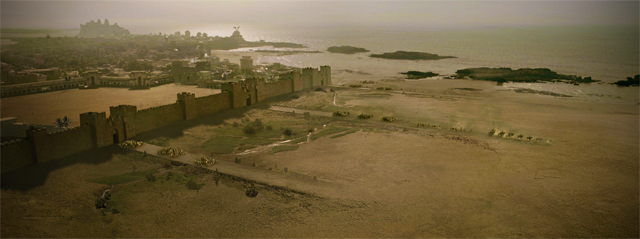
The grandeur of Slaver's Bay continues with the sunny city of Astapor.
Known for the quality of it's slave-warriors, the Unsullied, Astapor became a very well known fortress across it's continent.
Ao contrário da sua cidade-vizinha maior, a cidade é conhecida pelas suas praças e não os seus edifícios.
A Praça do Orgulho é um mercado aberto com uma fonte de água em tijolo com uma estátua de Harpia dos Astapori no seu centro, usada para escravos serem demonstrados a potenciais clientes.
Astapor's entrance | Image via Hielo y Fuego
As a way of reminding rebellious slaves of their impending doom, the entrance of Astapor is a remarkable place of misery where slaves are flayed and crucified until they die.
It's fitting name is the Plaza of Punishment, an entrance to show slaves what lies in their fate as soon as they are "recruited".
After buying slaves, their masters can entertain themselves in various ways. One of such uses is the fights in the Fighting Pits of Astapor - Douquor and Jothiel, in which the greatest crimes against humanity were comitted.
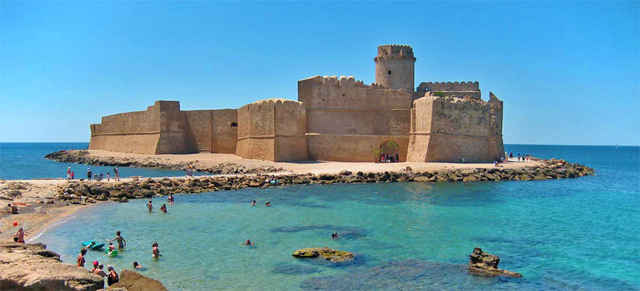
La Castella | Image via Calabria Tours
Contrary to the suffering and sadness portrayed by the inhospitable land of Astapor, the place used to portray it is the happy sunny Fort of Le Castella, in the Ionian coast of the Southern part of Italy!
This fort can only be accessed by foot by a small path surrounded by sea in all directions.
Its one of the seven forts that surround the coast of the Crotone region.
It has an irregular layout, drawn by the Argonians, surrounding a fortification built long ago in 204 B.C.
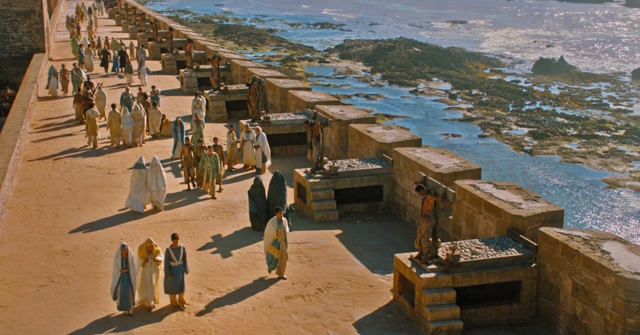
Plaza of Punishment | Image via Cadena Ser
At night, the water's reflections shine across the stone walls, making it into a marvellous view for the villa in front of it.
Although, is this italian beauty enough to make us forget the atrocious ficticious crimes commited here?
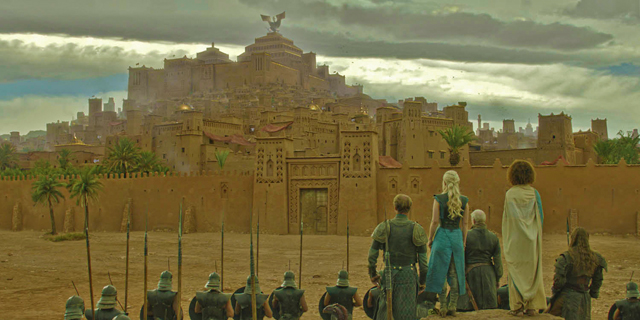
Daenerys' entrance in Yunkai | Image via HBO
Before we finish our visit through this bay of atrocities, let us take a quick gander at the conquered city of Yunkai.
Known as the Yellow City, it's the closest city to Meereen, also in the northeastern corner of the bay, with the isle of Yaros to it's side, as it's prime view.
Around it, nothing is to be found, like it's production - nothing but slaves.
Built from yellow bricks caving in from their age the slaving city has high walls protecting the great stepped piramids, addorned with the city's symbol, like it's brethren - the Harpy.
Defended by 5000 slaves, the noble slaving families feel safe inside the walls, even though it is not a warrior-slave factory like Astapor. Instead, it's slaves aren't eunuchs, they are whores for hire.
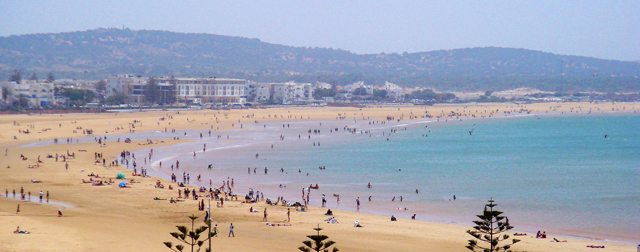
Essaouira beaches | Image via Wikipedia
To portray Yunkai, Essaouira in Morocco was used for the exteriors - this is where the finale of the third season took place, Mhysa.
It's a city in the West coast of the country, now used as the prime beach resort for the region.
Originated from the orders of Diogo de Azambuja, as a Fort for the Portuguese Empire in the 16th century, it was conquered shortly afterwards by the local inhabitants, transforming it into an international port.
It was never a big settlement, but it is now protected as a World Heritage by UNESCO for it's walls and old artillery pieces from the Portuguese military of the time.
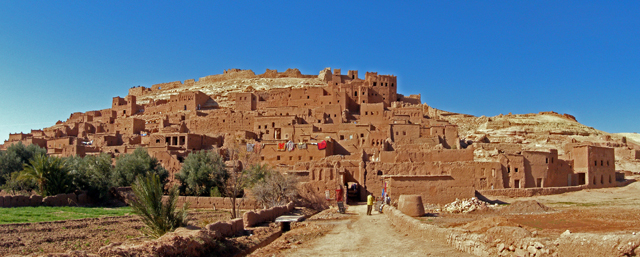
Aït-Ben-Haddou | Image via Wikipedia
For the fortification from which the Yellow City is made, Ait-Ben-Haddou was chosen for it's traditional earthern architecture. It's a forgotten relic from a distant past of the Quarzazate region in southern Morocco, living amongst us as a portrait of a culture still inhabited until this day.
During it's prime, it was a place of commerce. Now it's a shambling pool of history made out of fortified houses of different sizes and luxury, but all united in the rustic construction techniques that define the place.
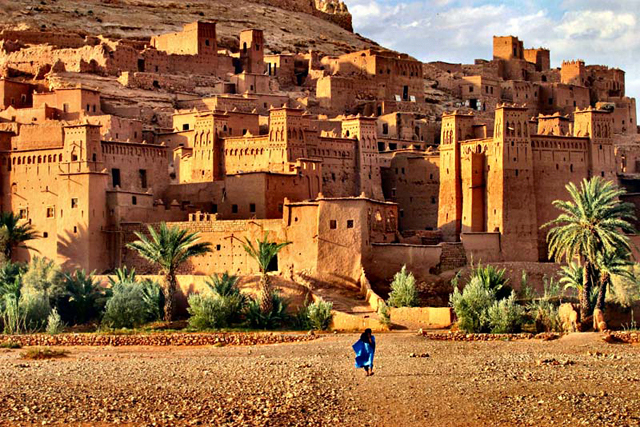
The Fort-Houses of Aït-Ben-Haddou | Image via Trek Earth
After travelling across the three cities that surround the mediterranean sea, we have found unequal richness in our world yet again.
Looking at it from either a fantasy or real perspective, we have saw stories of epic conquests and settlements alike.
Is this the future of the television industry? A unique portray of our beautiful world pretending to be another?
Dare I say that we want more! And so we shall have, next week on HBO.
Click here for the first part of the Game of Thrones Architecture series, e and it's sequel.