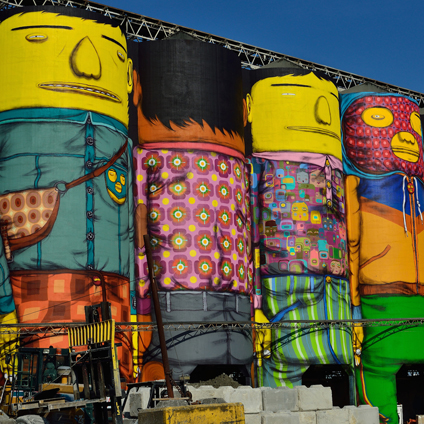



The World Cup's Architecture
Get to know the 12 stadiums for this event

|
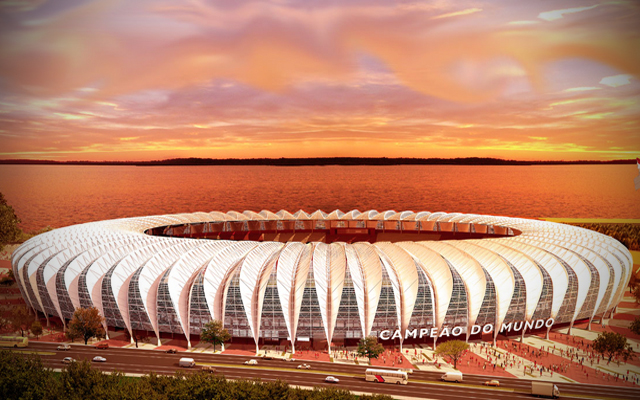
Beira Rio Stadium, Render | Image via Infobae
Amongst the 12 ellected stadiums that will host the Soccer World Cup in Brasil, most suffered big remodelling projects and some were built from scratch.
We present to you all the buildings, their details and the stories that accompanied the construction process.
Follow the World Cup and meet the stages for all the games!
Pantanal Stadium – Cuiabá
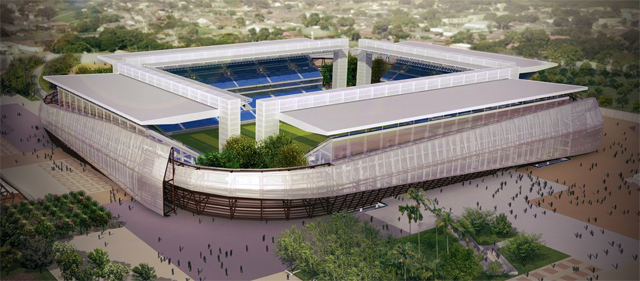
Pantanal Arena, Render | Image via Wikipedia
Construction: 1999
New stadium: 2010 – 2014
Spectator seats: 42968
Architecture by: GCP Arquitectos
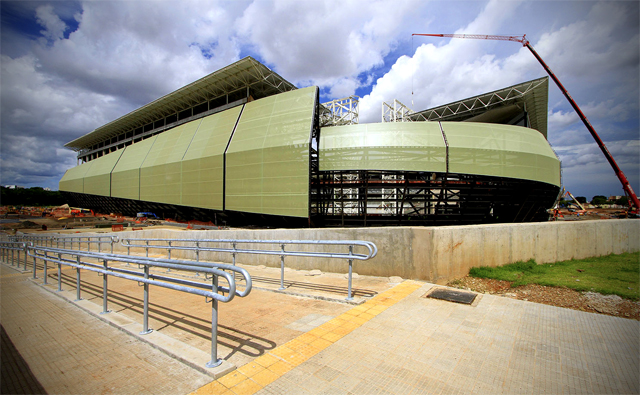
Pantanal Arena, Exterior | Image via Globo
Since this arena is located in a region filled with fauna and flora, this building was expected to present a strong ecological component. Through it's project phase unto it's construction it came through with the expectations.
This stadium replaces the old, demolished José Fragelli stadium through the use of modular structures.
It can be reduced to 28000 seats after the world cup, a suficient number for the local needs.
Besides that capability it will also feature spaces for multiple usages, like expositions, fairs and other shows.
The rooms demanded by FIFA were placed under the seating for later removal and transformation into a convention center.
This complex has 15000 parking spaces, 108 cabins and press spaces, as well as buisness seats and a honor tribune. On the exterior, it also features hotels, restaurants, lakes, woods and a walking path.
The first game in this new stadium was held in April of this year, before being delivered to FIFA on the 21th of May.
Mineirão Stadium - Belo Horizonte
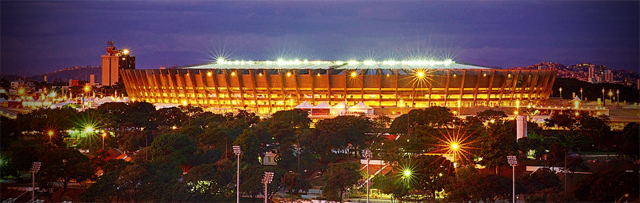
Mineirão Stadium, Exterior | Image via Fifa
Construction: 1965
Remodelling: 2010 - 2012
Spectator seats: 57483
Architecture by: Eduardo Mendes Guimarães Júnior Garreto BCMF, GPA&A and GMP
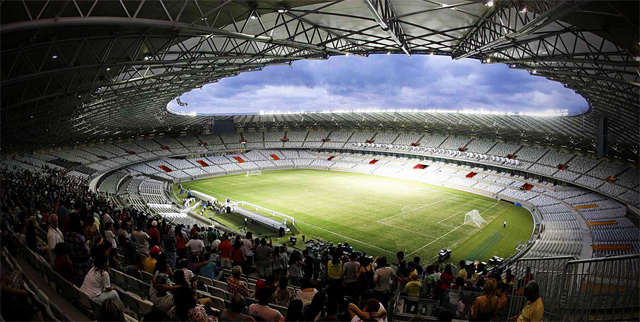
Mineirão Stadium, Exterior | Image via Mundial Futebol
This remodelling project kept the original facade but proceded in lowering the field whilst reworking it's coverage.
The accessibility conditions improved by reducing the number of spectators and increasing the parking spaces, among other measures. Meanwhile, outdoor restaurants were built with stages for events during and after the world cup.
These alterations were made with sustainability in mind. Rainwater collection, storage and reusage are all made through the roofing.
After almost 3 years of construction work, the reinauguration was held in the 21th of December 2012, making this the second stadium built for the big games.
Brasilia National Stadium – Brasília
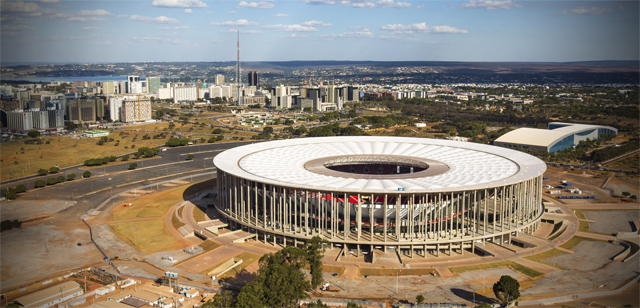
Brasilia National Stadium, Exterior | Image via Infobae
Construction: 1974
New stadium: 2010 - 2013
Spectator seats: 72788
Architecture by: Eduardo Castro Mello and GMP
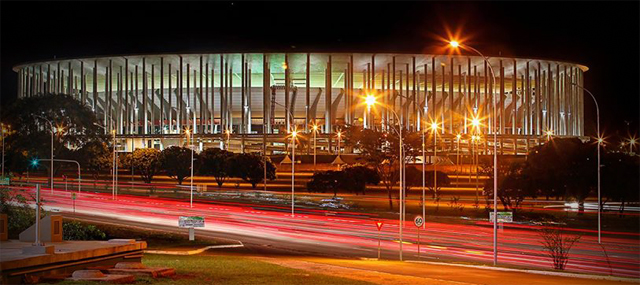
Brasilia National Stadium, at night | Image via Copa 2014
In place of the old Mané Garrincha stadium, a new one with a new facade was made.
It features a new metal roofing, new benches and a lowered playing field to give out an optimal game viewing experience.
The new stadium now has 335 interior parking spaces, an auditorium, a police base of operations, a health center, an underage tribunal, a cinema, convention center and a theater.
In total it has 74 cabins, 1112 VIP rooms, 40 bars, 14 snack bars and 2 big restaurants.
In the exterior, there are almost a hundred thousand square meters of space for bus use, 8000 public parking spaces and 222 VIP parking spaces, along with some aditional 2850 press parking spaces.
This building takes pride on being built around sustainability by being equipped with a solar energy system and a rainwater collection system.
Beyond that, it also features a good natural ventilation for the interiors, due to its design.
The roofing's material itself is sustainable. Produced in Japan, its a titanium dioxide membrane that helps remove polutant gases from the atmosphere. Not only that, but it also saves the environment by ease of maintenence and cleaning.
It's inauguration was held five months after scheduled, in May of 2013, with a kick off the field by the president Dilma Rousseff.
Baixada Stadium – Curitiba
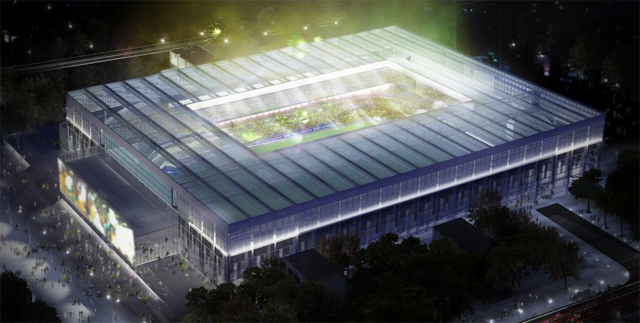
Baixada Stadium, Render | Image via Copa do Brasil 2014
Construction: 1914
Remodelling: 2012 – 2014
Spectator seats: 42000
Architecture by: Carlos Arcos
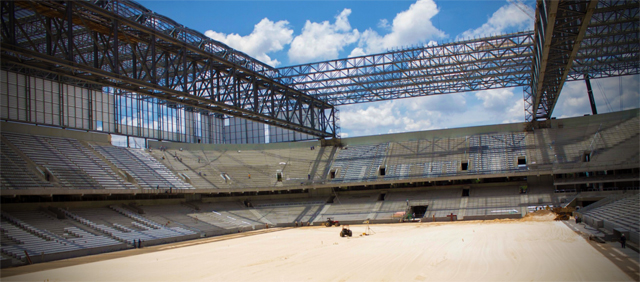
Baixada Stadium, Construction | Image via UOL
The 1914 stadium was already remodelled in 1999 as one of the most modern and best equipped stadiums in Brasil but it still needed some work done in order to comply to FIFA demands.
The inauguration of this stadium was postponed several times, even granting it some threats from FIFA, but it took place eventually on the 14th of this year's May.
Castelao Stadium – Fortaleza
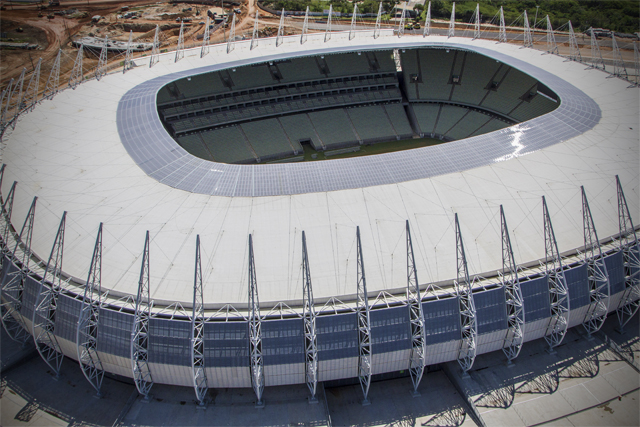
Castelao Stadium, Aerial view | Image via Copa 2014
Construction: 1973
Remodelling: 2011 - 2012
Spectator seats: 64846
Architecture by: José Liberal de Castro, Gerhard Ernst Borman, Reginaldo Mendes Rangel, Marcílio Dias de Luna and Ivan da Silva Britto, Vigliecca & Associados
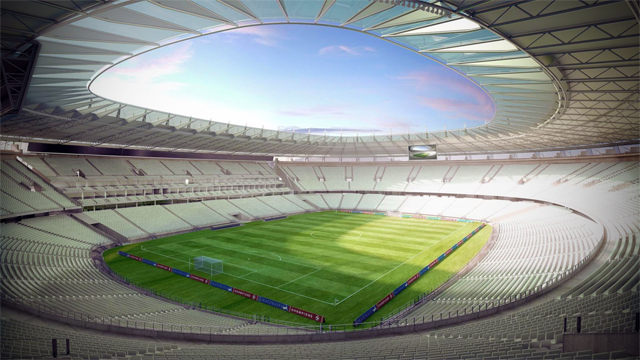
Castelao Stadium, Interior | Image via Cupom
Aproximately one fifth of the old stadium was demolished, granting it a World Demolition Award.
This spured significant remodelling, making it a modern multiusage stage featuring renowned sustainability.
Just like the other stadiums made for the event, the field was lowered and the seats were made to be closer, making the spectacle more enjoyable for live fans. The covering helps by extending over all viewers, bringing a better confort and natural ventilation.
This intervention respected all of the new demands by introducing new cabins, VIP areas, a press room, wardrobe areas, control rooms, lounges and restaurants.
The stadium now is equipped with an underground parking for 4200 and in place of the old exterior parking, a 78850 square meter promenade was made to welcome the new guests. The complex also has an olympic center, cinemas and a hotel.
The reinauguration was held in the 16th of December, making it the first stadium to be completed.
Amazonia Stadium – Manaus
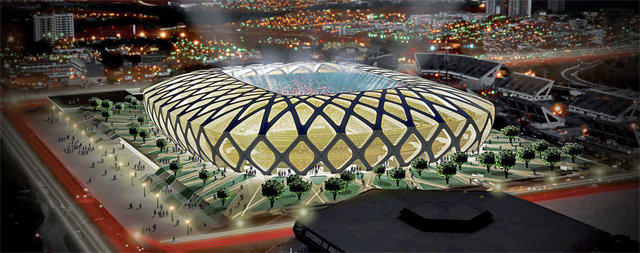
Amazonia Stadium, Render | Image via Copa 2014
Construction: 2011 - 2014
Spectator seats: 42374
Architecture by: GMP Arquitectos
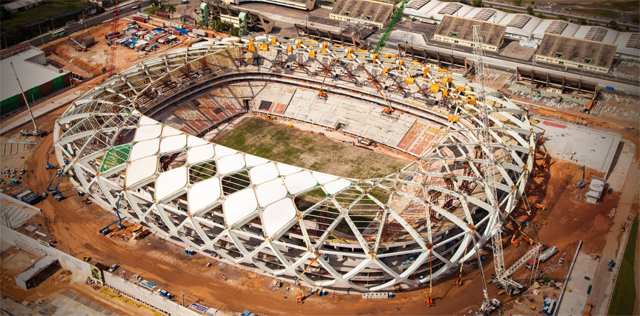
Amazonia Stadium, Construction | Image via UOL
With the particular setting of being close to the biggest continuous forest in the world, this work revealed strong amazonic and sustainable influences.
Consequently, in the demolition phase, 95% of the materials were reused.
The metallic structure in the roofing was made to be a reinterpretation of a straw basket typical for this region.
Through this coverage, rain water will be stored for reuse in bathrooms and the maintenence of the playing field.
Besides these measures, the energy to feed the stadium is solar, capitalizing on the intense sunlight of the region.
Some walls even feature green covering to control the interior temperature of the stadium!
The new stadium answers the needs for accessability and confort, along with the cabin and restaurant count needed.
After some postponing, the inauguration took place on the 9th of March, 2014.
Dunas Stadium – Natal
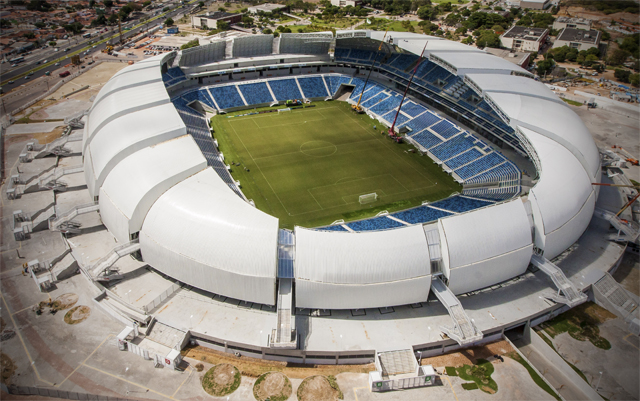
Dunas Stadium, Aerial view | Image via Amazon
Construction: 2011 – 2014
Spectator seats: 31375
Architecture by: Populous and Coutinho, Diegues e Cordeiro Arquitetos with Grupo Stadia
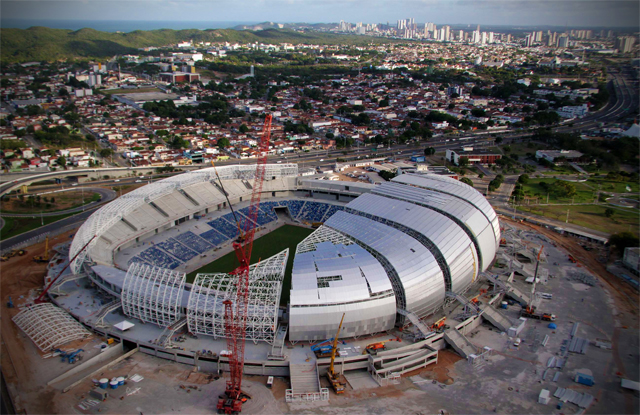
Dunas Stadium, Construction | Image via Blog do BG
The construction of this new stadium implied the demolition of the old Machadão Stadium, the old Humberto Nesi gym, a kart racing track, an administrative center and religious grounds.
The project was inspired in the characteristics of sand dunes, resulting in a wave-like structure that works as roofing.
The structure also permits an increased ventilation and natural light entry, presenting itself as another sustainable landmark with rain water collection and usage features.
Besides all this, it also has 4 lounges, 39 cabins, 25 snack bars, 30 bathrooms and indoor and outdoor parking.
The inauguration was in the 22th of January, 2014.
Beira-Rio Stadium – Porto Alegre
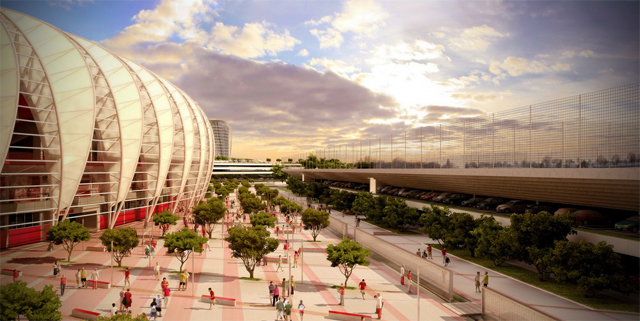
Beira-Rio Stadium, Setting | Image via Skyscraper City
Construction: 1969
New stadium: 2011 - 2014
Spectator seats: 51300
Architecture by: Hype Studio
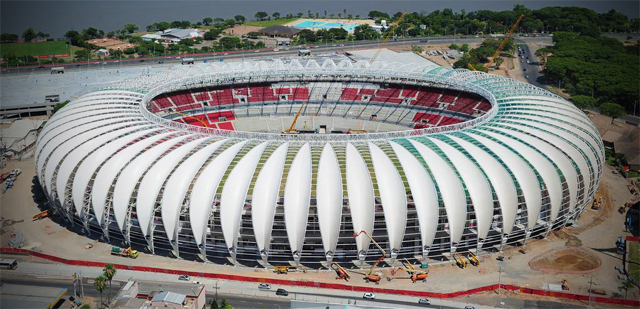
Beira-Rio Stadium, Aerial view | Image via Bola em Jogo Beira-Rio
The new stadium came as a replacement for the old Beira-Rio Stadium, with the name of José Pinheiro Borda, a portuguese construction magnate.
This work included a metallic roofing over the superior ring, protecting the fans which now are distributed amongst chairs over the new gym and training facilities inside and in it's surroundings.
Up until today, it still is not approved by FIFA.
Itaipava Pernambuco Stadium – Recife
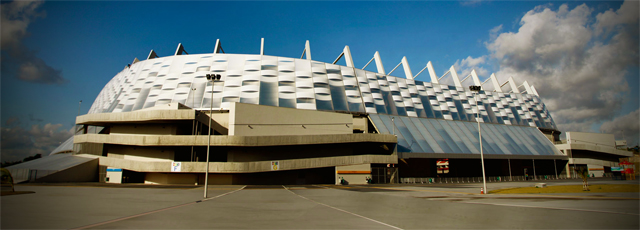
Itaipava Pernambuco Stadium, Facade | Image via Itaipava Pernambuco
Construction: 2010-2013
Spectator seats: 46000
Architecture by: Fernandes Arquitetos & Associados
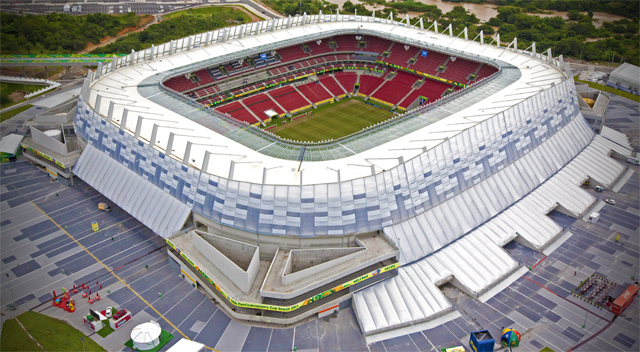
Itaipava Pernambuco Stadium, Aerial view | Image via Wikipedia
This complex is located in São Lourenço da Mata and features restaurants, bars, shopping, cinemas, theater, a hotel, a convention center and a total of 4700 parking spaces.
The stadium has the look of a transparent car tire with a varying facade color scheme that will permit a constant change of visuals.
It was opened on the 14th of May, 2013.
Maracanã Stadium – Rio de Janeiro
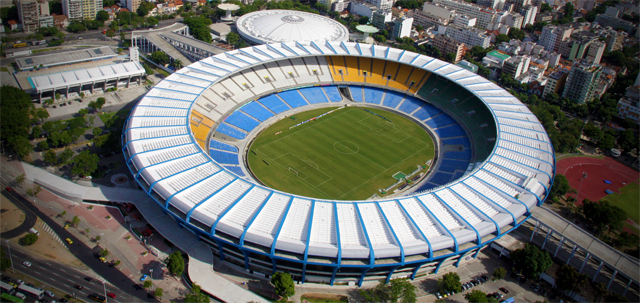
Maracanã Stadium, Aerial view | Image via High Quality Wallpaper
Construction: 1948
Remodelling: 2010 - 2013
Spectator seats: 73531
Architecture by: Miguel Feldman, Waldir Ramos, Oscar Waldetaro, Rafael Galvão, Orlando Azevedo, Antônio Dias Carneiro e Pedro Paulo Bernardes Bastos and Fernandes Arquitetos & Associados
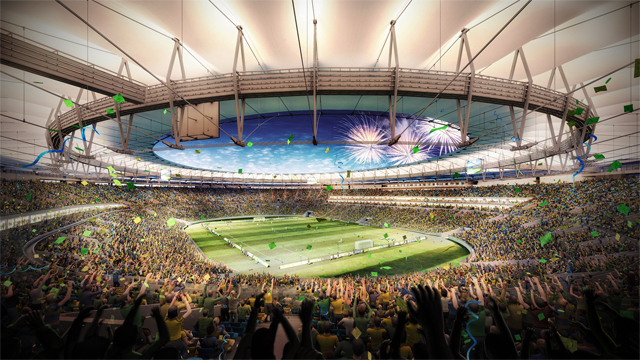
Maracanã Stadium, Interior rendering | Image via O Girassol
The Maracanã stadium was built in 1948 for the world cup of 1950, since then it has suffered many changes.
In 2014 it'll be center stage for the new event, with the biggest number of games.
Safeguarding it's original conception, the present remodelling centered in the demolition of the lower ring.
Constructing a new seating with better visibility of the field and the replacement of the existing roofing in concrete by a tension-rigged membrane that takes advantage of rain waters for reuse.
The chairs were replaced, the ramps increased, bathrooms, bars and VIP areas were created and equipped with climatized cabins and a lounge with exclusive food services.
Even during the construction works, the stadium was still used and it's reopening occured in the 2th of June, 2013.
Fonte Nova Stadium – Salvador
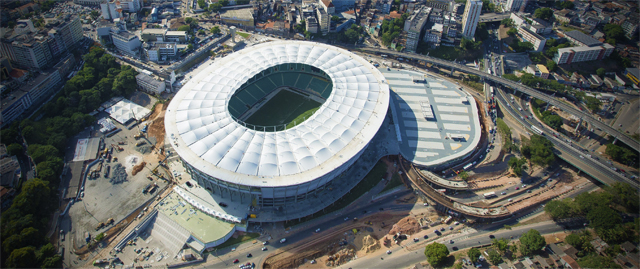
Fonte Nova Stadium, Aerial view | Image via Wikipedia
Construction: 1951
New stadium: 2010 - 2013
Spectator seats: 52048
Architecture by: Setepla Tecnometal Engenharia, Tetra Projetos and Schulitz + Partner Architekten
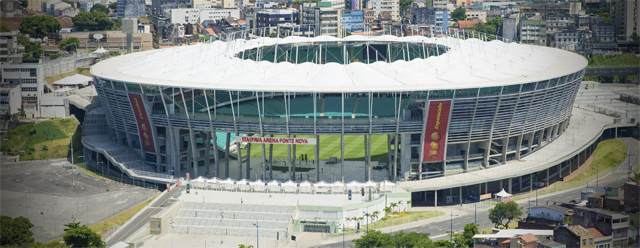
Fonte Nova Stadium, Facade | Image via Wikipedia
The old Octávio Mangabeira stadium was imploded in 2010 and in it's place the new Salvador-based stadium was erected.
This new construction combines the tradition of the old stadium, keeping the horse-shoe shape and opening itself to the Tororó dam.
It features a light metallic roofing that covers all of the new seats and guarentees good natural ventilation.
The field was also lowered in this intervention for the 3 levels of benches, multiple cabins, panoramic restaurant, press room, snack bars, buisness center, stores, a museum and 2000 parking spaces.
The goal here was to build a stadium that could serve different uses for different kinds of shows throughout the year.
It was the third stadium to be complete in time, by the 7th of April, 2013.
São Paulo Stadium – São Paulo
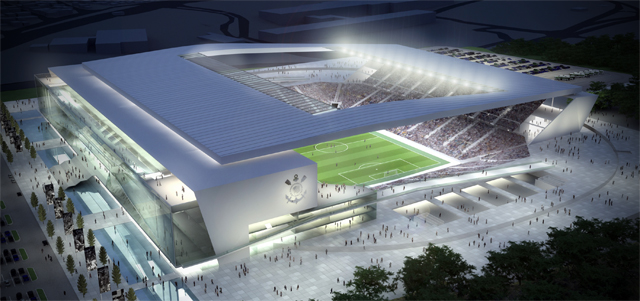
São Paulo Stadium, Render | Image via Fifa
Construction: 2011 - 2014
Spectator seats: 69160
Architecture by: Aníbal Coutinho
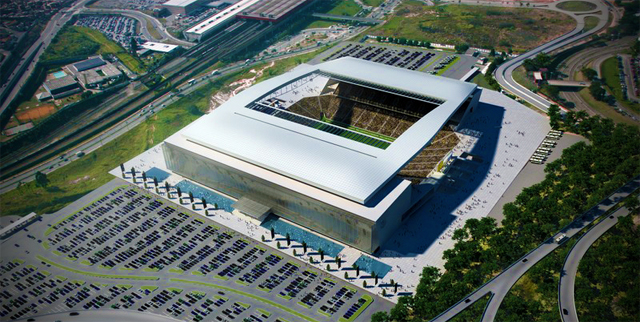
São Paulo Stadium, Exterior | Image via Mundial Futebol
As promissed for quite some time, the dream of building a new stadium finally had it's kickstart with the Soccer World Championship event coming.
The rectangular shape of the stadium divides itself into two buildings: the main to the west side and another to the east.
The West incorporates the VIP rooms, equipment and tv crews.
The East has one of the biggest video screens in the world.
It has 3 bars and restaurants, a night club, several stores, an auditorium, a convention center and a museum.
The coverage has several layers for thermal and acoustic comfort as well as rainwater collection services.
It suffered several delays but it eventually openned on the 18th of May, 2014.