


Frank Gehry
Bold and Controversial

|

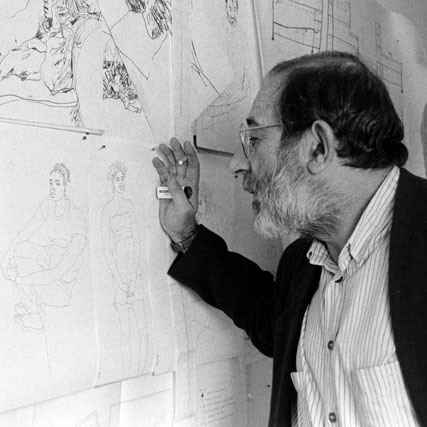
Frank Gehry | Photo: © Martin Crook
Born February 28, 1929 in Toronto, Canada, Frank Gehry is one of the most famous and enigmatic contemporary architects, referenced by its deconstructivist style, using bold forms and innovative materials.
Despite revealing a close relationship with art since childhood, he experienced different areas before making his professional choice. Only 18 years old, he moved to California where he was a truck driver, a radio announcer and attended chemical engineering. His childhood memories, in which he spent entire afternoons with his grandmother creating cities and buildings with wooden blocks, was determinant for choosing a career in architecture.
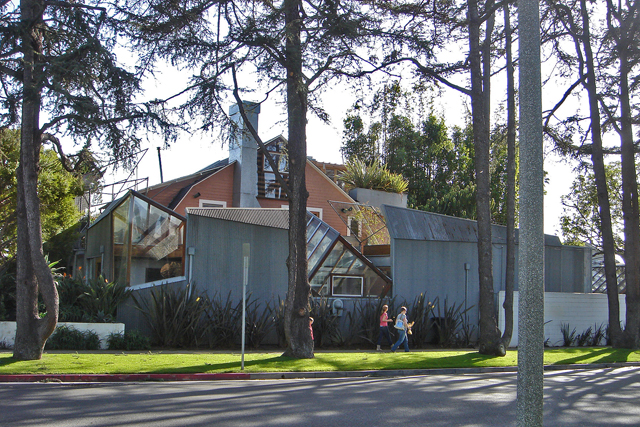
Frank Gehry's house, Santa Monica | Photo: © Cygnusloop99 / Wikimedia Commons / CC-BY-SA-2.0 / GFDL
Many of his buildings are among the most important works of contemporary architecture, having become world-renowned tourist attractions, including homes, museums and corporate headquarters.
His bold designs are dominated by curved structures, generally metal. For Frank Gehry, the satisfaction is not in the result but in the process, the possibility of the sketch.
In 1989 he was awarded the Pritzker Architecture Prize, having been referred by the jury for his outstanding experimental process, a unique, following his own firm and consistent path which resulted in his success and critical acceptance.
A few major projects that marked the beginning of his career are the Walt Disney Concert Hall in downtown Los Angeles, USA, the Dancing House in Prague, Czech Republic, and his own home in Santa Monica, California, USA.
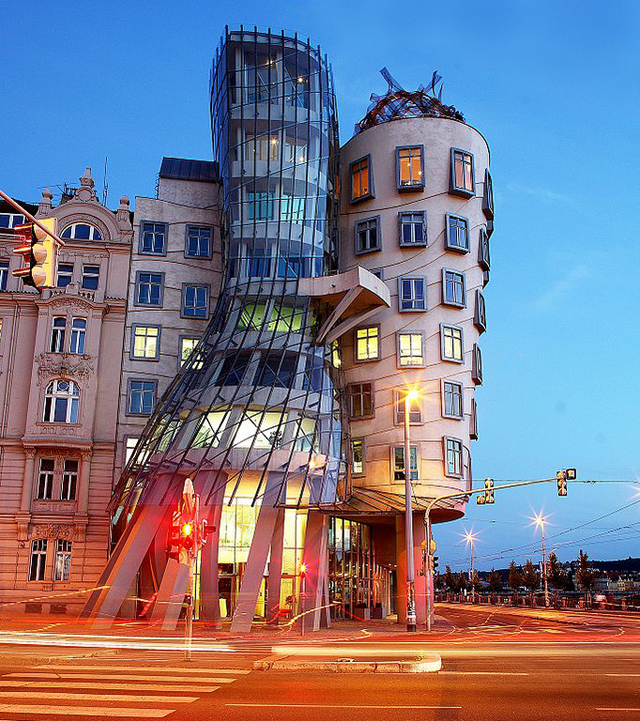
Dancing House, Prague | Photo: © Bryan / Wikimedia Commons / CC-BY-SA-2.0 / GFDL
But his most famous work is the Guggenheim Museum in Bilbao, Spain, opened in 1997, extending its level of international recognition. Hailed by The New Yorker Magazine as a "masterpiece of the twentieth century" and by architect Philip Johnson as "the greatest building of our time", the museum has become famous for its stunning bold shapes but also the economic impact it has had on the city.
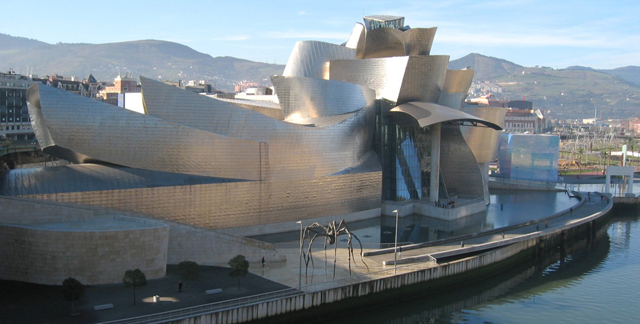
Museu Guggenheim, Bilbao | Photo: © MykReeve / Wikimedia Commons / CC-BY-SA-3.0 / GFDL
After the huge success of this project, critics began to refer to the economic and cultural revitalization of cities through innovative and iconic architecture as the "Bilbao effect". In the following years there were many attempts to replicate this effect through large scale commissioning of architecture projects, some successful, as the expansion of the Denver Art Museum, designed by Daniel Libeskind, or the Walt Disney Concert Hall, by Frank Gehry himself, and other less successful, as the controversial Experience Music Project Museum in Seattle, also by Gehry.
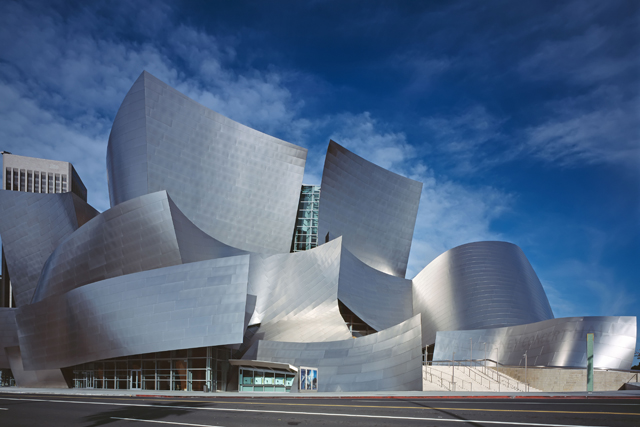
Walt Disney Concert Hall, Los Angeles | Photo: Carol Highsmith / Wikimedia Commons / Public Domain
Vanity Fair magazine has even labeled him as "the most important architect of our age".
Despite the recognized international success, the reaction to Gehry’s work is not always positive. In addition to budget differences issues with some of his projects, criticisms of his works include allegations that his buildings waste structural resources, consisting of forms without function, which seem to belong somewhere else or that are apparently designed without considering the climate and other site specific conditions.
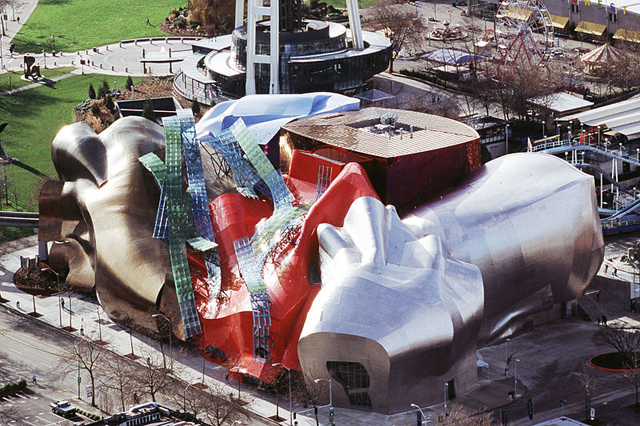
Experience Music Project, Seattle | Photo: © Baileythompson / Wikimedia Commons / CC-BY-SA-3.0 / GFDL
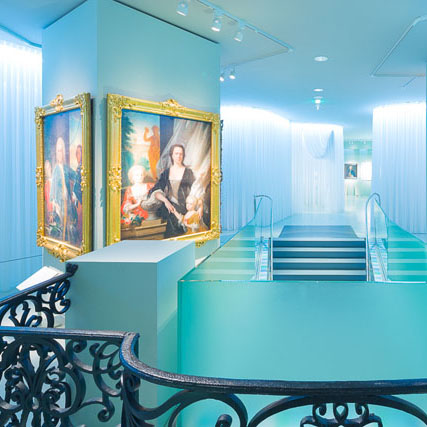
Currently are under construction, all over the world, many relevant works designed by Frank Gehry, among which stand out the Fondation Louis Vuitton pour la création in Paris and Biomuseo in Panama City, both with completion scheduled for 2014, and the Guggenheim Abu Dhabi on Saadiyat Island, UAE, to be completed by 2017.
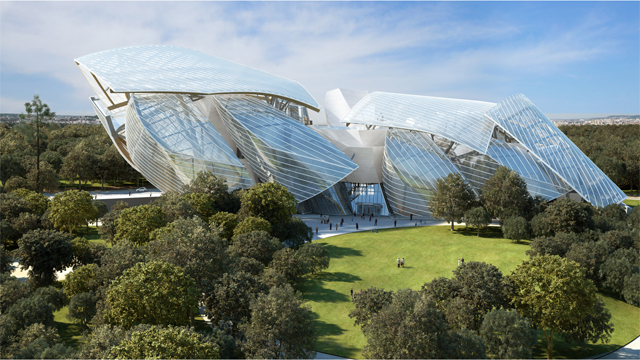
Fondation Louis Vuitton, Paris | © Gehry Partners / Louis Vuitton
Frank Gehry is also responsible for some major projects still under development, as Mirvish Towers in Toronto, a center for performing arts at the World Trade Center site in New York, or the new headquarters of Facebook in Menlo Park, California.
The contribution of the work of Gehry was decisive for changing the image of contemporary architecture. More than an architect, he is above all an artist who risks in experiencing something new, never seen before, standing out for his own peculiar creative way, so genuine, distinctive, perverse and original.