


Interface Design
Technology and everyday objects

|
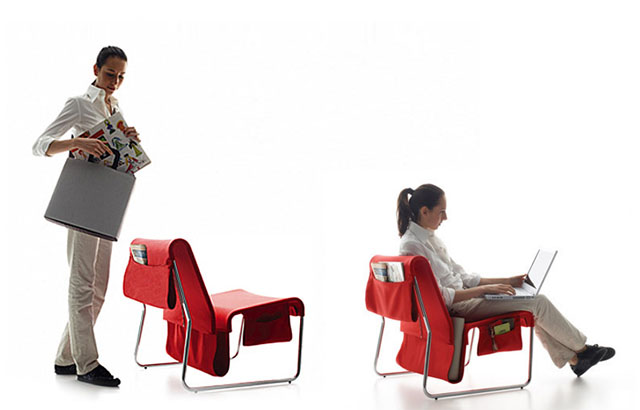
Farallon chair by Yves Behar | Danese
Electronics are increasingly present in our daily lives. The development of technology in everyday life provided the appearance of high-performance objects and the multiplication of their capacities. The microprocessor was incorporated in almost every "operating" system, from a simple dishwasher or washing machine, to cars or mobile phones.
The introduction of electronics in everyday objects demonstrated the need from such equipment manufacturing firms to meet the human needs for comfort. Some of these devices are radically changing our everyday life by creating new relationships between technology and physiological reality, anthropology and human body.
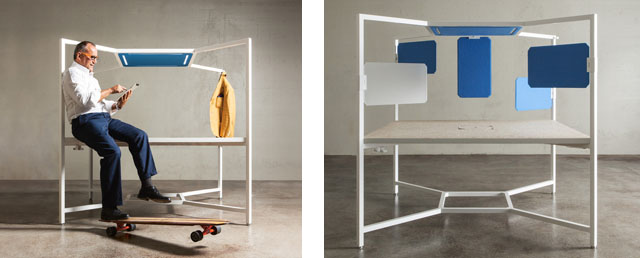
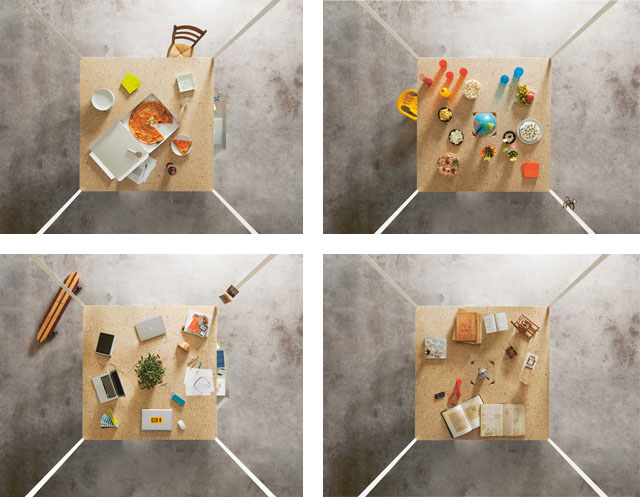
Hub by Matteo Ragni | Fantoni
Hub is a revolutionary interface to work more informally. Today we live in an increasingly nomadic way, in contrast to the previous form, which was monotonous and repetitive. The workspaces today are hybrids, constantly changing and have to adapt to those who work in them, new challenges. Hub is a new concept designed to share ideas, a space for reflection, individual work and where you can also eat whenever you want. Some sort of box without walls, fully customizable, inspired by the work of Bruno Munari and its design of a space where teenagers can simultaneously study, rest, play and interact with each other.
In most cases, technological developments enabled the appearance of new types of objects such as the Power Cube.
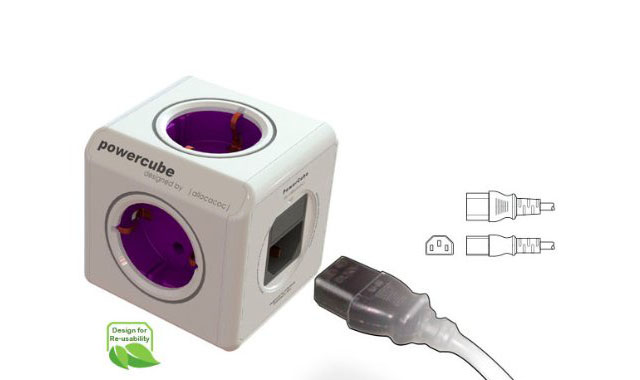
Power Cube by Yixia Jiang e Arthur Limpens | Allocacoc
The Power Cube is a modular power splitter available in 4 varieties.
These are useful objects that address simple problems such as charging the batteries of all equipments at the same time.
Designers have an ethical and social responsibility, and they cannot continue designing considering merely new styles, new forms or fashion. Today, design is not about creating a particular object, is about its relationship with Man.
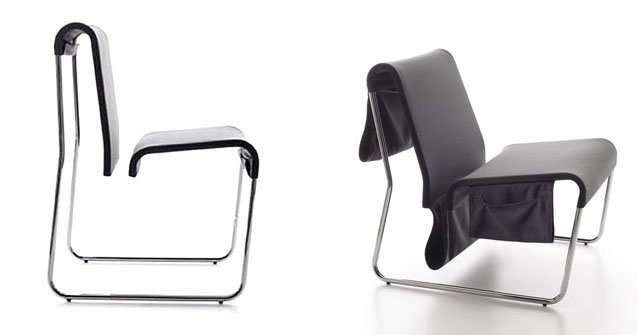
Farallon chair by Yves Behar | Danese
Multipurpose chair. It is intended for domestic environment and has different accessories for you to store various objects. The bag between the seat and the back allows you put your laptop when you are not using it. The bags in the side and back of the chair can be used to place the phone and / or tablet or other electronic devices.
It is in this relationship that Interface Design arises. The problem is not in technology but in the interface between objects such as mobile, tablet or laptop.
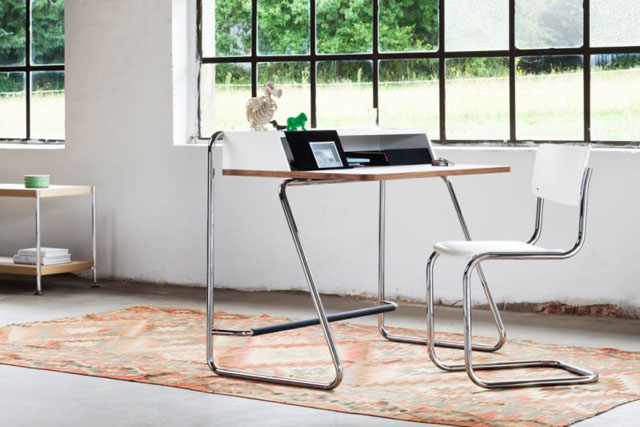
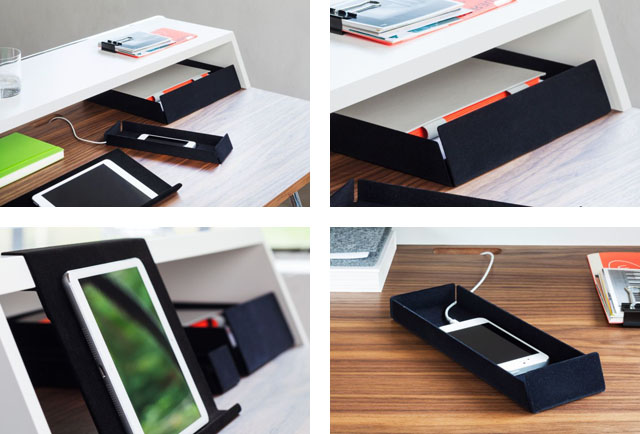
Desk S 1200 by Randolf Schott | Thonet
Inspired by the classic tubular steel furniture, the S1200 desk, was designed for the domestic space. It is a work desk and an interface with practical and functional accessories that enable interconnecting different peripherals. The desk has a pencil holder, a tray for Din A4 documents, a cable organizer and support for tablet and phone.
Our houses became very complex spaces, populated by electronic appliances that communicate with each other, but have to be successfully integrated in the domestic context.
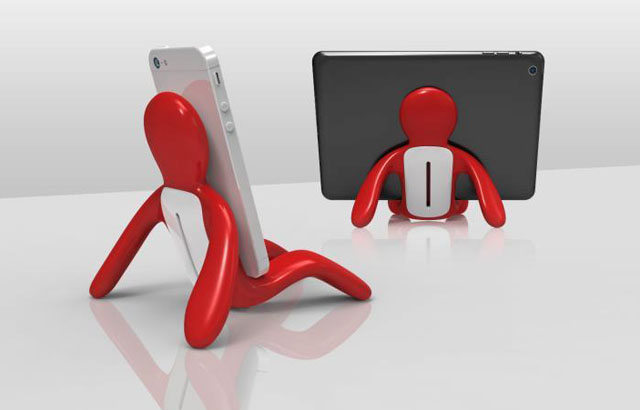
Big Brother by Luca Trazzi | Mr & Mrs
Big Brother is a seated figure which serves as support for a mobile phone or tablet. Its surface is made entirely of rubber to prevent the devices from slipping. At the back you can put a scented capsule which can be replaced. There are various fragrances.
At first, the fascination with this type of electronic devices was in the symbolic value of the technical content.
Today, the fascination we seek lies in the comfort of our daily lives, in more humane and sensitive interfaces.
Text: Nuno Ladeiro