


Living Cities: The skyscrapers of the future
New York in 2040Images via Metropolis Magazine

|
“How will the world capital of New York house a million new inhabitants by the year 2040?”
This was the question that started Metropolis Magazine's architecture and design competition: Living Cities.
Co-hosted by the Steel Institute and the Ornamental Metal Institute of New York, it comes as no surprise that metal structures were key for these 30 to 40 storey-high projects. Besides those two demands, the goal was to envision the future of social housing in New York!
The contest involved architecture and engineering students and professionals working towards the ten thousand dollar prize and the recognition that would follow the January deadline. After careful consideration, two winners and four runner-ups were chosen!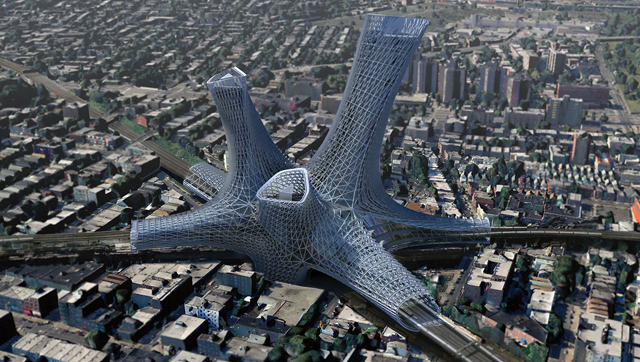
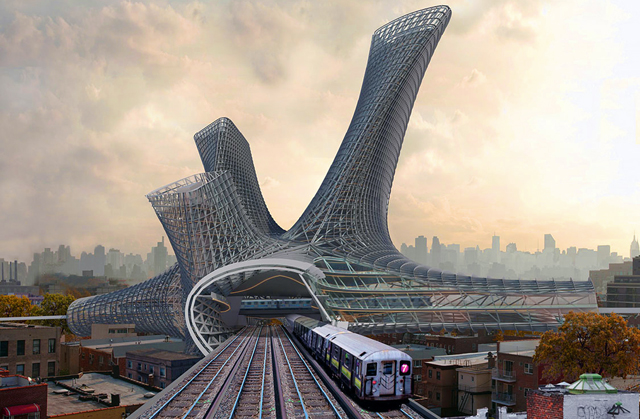
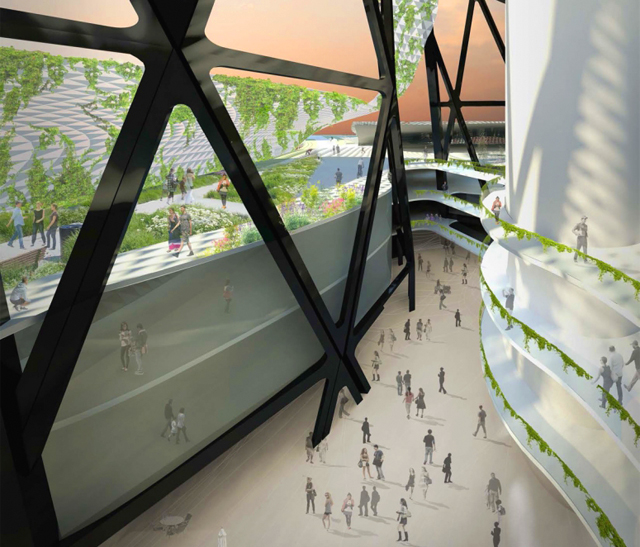
Urban Alloy | Design by AMLGM
Urban Alloy, a coral-like dynamic structure that serves as an engine for innovation and social cohesion.
Grown out of the pre-existing roads and railways untill it reached the sky, this colossus proposed a strong yet light metalic structure that enabled the creation of gigantic cantilevers answer to the spacial needs of the project without increasing it's ground-floor area substantially.
The outer shell of this project reflects a desire to optimize the shading and lighting of this complex volume. The complexity derives from a surface design that changes from cylindrical to prismatic shapes to adjust itself to the different heights of the various floors. The flexible structure became necessary to create unique environments with varying solar expositions for each corner of the building.
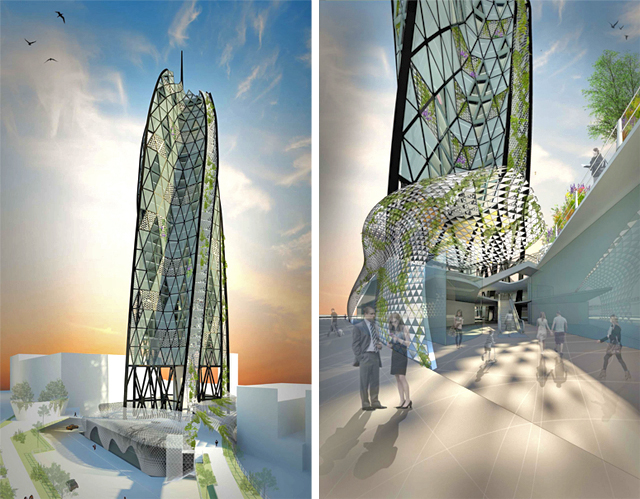
Vivo on High Line | Design by NBRS+Partners
In 2009, the inhabitants of New York were introduced to the High Line Park, a railway elevated over Manhattan which was reconstituted into an urban park of abundant flora. After it's retirement from public transportation, it since has been used as a relaxing pathway to connect with nature over the big apple.
The second winner of the Living Cities contest, "VIVO", takes the High Line concept and elevates it into the skies! Innovation takes shape as a green vertical intervention of imposing sustainable consequences on the city. Enveloping the High Line and folding it like an origami, it becomes a nexus of various different paths that all lead to this center of flexible life force. The metallic structure acts as a way of liberating the interior space and enabling variations of use across the building'ss life span, mimicing the seasons and ages of life itself, cultivating an authentic urban ecosystem.
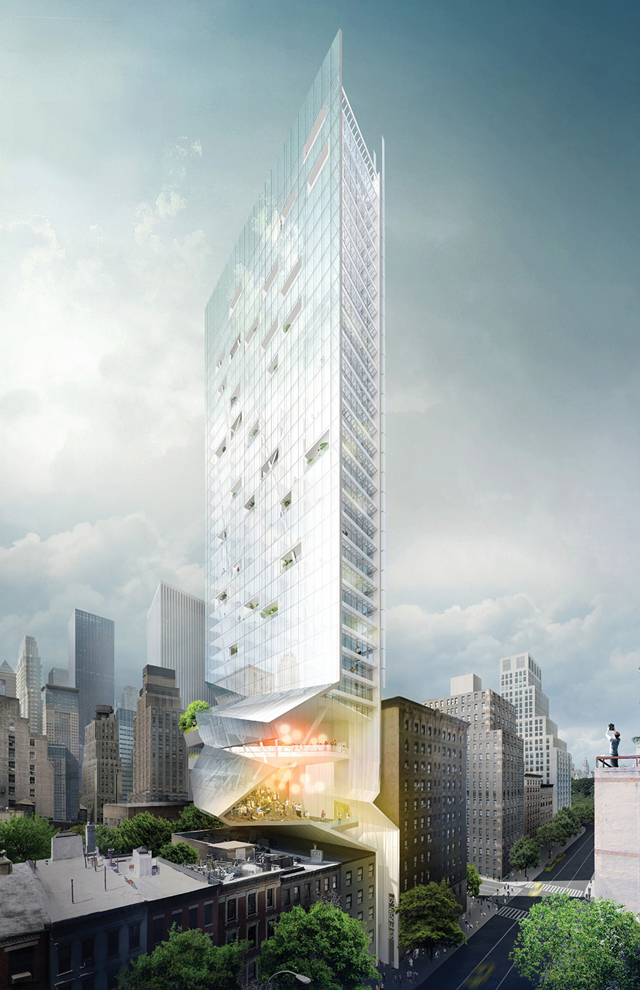
New York Tomorrow | Design by Airat Khusnutdinov and Zhang Liheng
As an introduction to the runner-ups, we were introduced to a work of unequal imagination and sleekness: The New York Tomorrow. In contrast to the anonymity of the dwellings of Midtown Manhattan's neighborhood this proposal distinguishes itself by the way it takes control of its surroundings. Taking advantage of it's metallic structure to the maximum, the building sits upon small area only 120 square meters to hold it's impressive 130 meters of height!
The project divides itself into three main parts: The ground floor support; The great atrium in in the middle; And a rectangular housing block like any other, sat upon the explosion of it's lower ends.
The support is given by a series of mega-columns that divide themselves, folding into an intricate fabric of columns, beams and metal rods that shape the public space above. This atrium is planned out to be used as a common workspace for small companies and other uses. From this metalic nest and it's social implications rises a classic rectangular prism with standarized floors with the power to adapt itself to any use necessary.
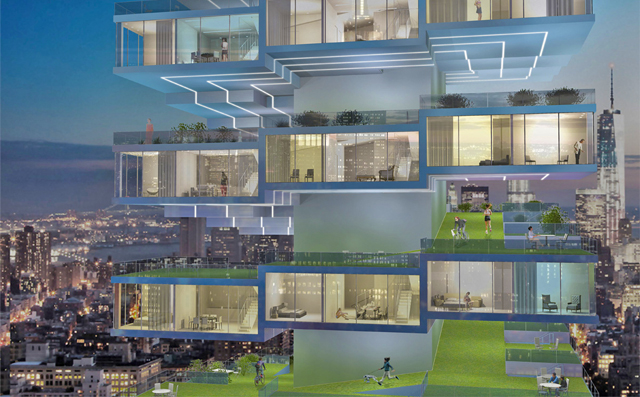
The Lawn House Tower | Design by Inki Hong and Solim Choi
For those who cannot decide between the advantages of the suburbs or the efficacy and proximity of city living, the Lawn House Tower creates an interesting middle ground. This complex was designed to house 200 families, and their own lawns, across several spiral layers of gardens with several active systems: Thermal control, wind dispersion, rain water storage and acoustic isolation, all to assure an incredible living conditions. Given its prefabricated nature, easy assembly and intelligent design, this candidate has raised the bar for sustainable architecture.
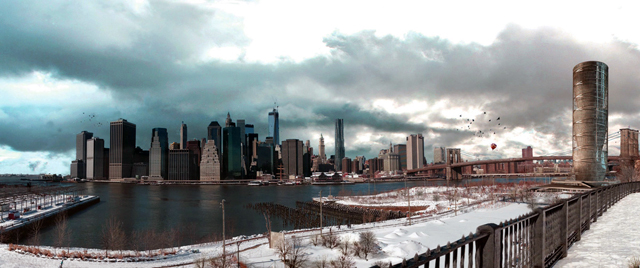
Flux Tower | Design by Juan Jose Garrido, Francisco Sánchez, Cristina Pérez, Verónica Vivó and Myriam Llorente
Unlike other proposals that ambition Manhattan's urban lifestyle, the Flux Tower reinvents the Brooklyn into a dynamic living machine. This 40 storey high cylindrical building mixes commercial and housing areas in three different modules encased in a glass outer shell that hides them into a single unit. What stands out the most in this proposal is the clever use of the intersticial spaces between it's units: community centers for recreation, restaurants, gyms and kindergardens that breathe the city itself.
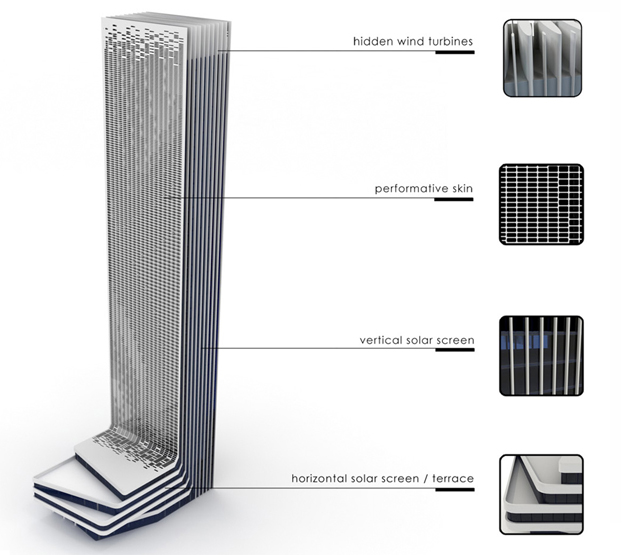
Bios Tower | Design by Enrico Tognoni and Davide Mariani
Even though New York's skyscrapers are the icons of numerous fantasies, they usually have a fairly real problem:
the heating of their glass and iron facades. Even though they define New York itself, the future demands more effective and comfortable designs. In the search for this future we have found Bios Tower, a skyscraper with the lean, mean means to succeed.
Its facade uses technology that filters solar radiation, creating optimum solar exposition for any of it's angles.
To feed these systems, wind generators were added to its roof top. To attend to its social needs, it's unique shape was drawn. The horizontal terraces in it base assure well-being and social interaction, whilst its vertical axis insures a multifunctioning grid of spaces and functions across it's floors.
With these surprising reinventions of social housing we have gathered a glimpse of what 2040 could be: The end of discomfort, waste and the victory of elegance in great design.
Images via Metropolis Magazine.