


When the building and object collide
Architecture with a little bit of fun

|
Creativity gains a new dimension when you give freedom to the artist.
Sometimes it's as simple as a small detail, the setting or an invoked emotion.
But today is not the day to talk about the small details, this time it's all about the big ones.
Here we care not for the setting, but for the things that stand out within, we're talking about when an object transcends its usual scale and becomes something memorable, albeit whimsical.
Be it for the sake of publicity, to make a statement or an act of eccentricity, there are many examples of object-like architecture.
It all started in 1813, in Paris, with the Élephant Bastille.
When the Bastille fell, in July of 1789, a replacement was required.
When they demolished the original and its materials were seized for the construction of the Pont de la Concorde, it was necessary to envision something to stand as a monument in its place. Who was up to the task? None other than Napoleon himself. Even though the Emperor, like the building, didn’t last much.
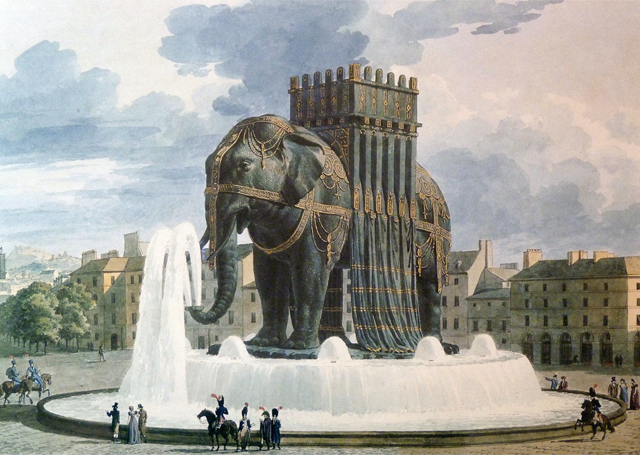
Envisioned like this painting by the architect Jean-Anoine Alavoine, it was meant to be a water fountain and a building itself but with Napoleon's defeat in the Battle of Waterloo the construction was halted and, some years later in 1820-1830, what remained was demolished.
Although when one thinks of object-shaped buildings one does not reflect upon the past, but instead about... Baskets.
Hand-woven baskets.
The most known building on this subject, and an unavoidable one, is the Longaberger Company's Headquarters in Newark, Ohio.
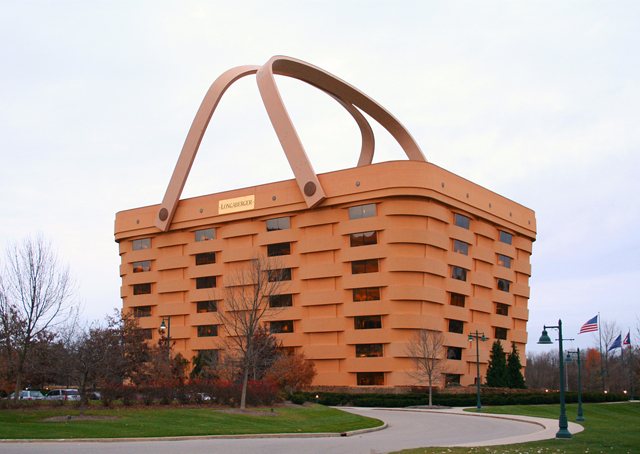
As a great, and literal, example of a big publicity stunt, the American handcrafted maple wood basket manufacturer, even though it is a family business, expanded to the point of making itself known all across its home state and even across the world with its colossal version of its main product- the Medium Market Basket.
The seven-storey building, designed by NBBJ Architects and by Korda Nemeth Engineering, opened in 1997 and quickly became a heavy-weight champion of extravagant architecture, figuratively and literally- the basket handles alone weigh 150 tons.
But not all of these buildings have to be about big companies or big events.
There are also more modest examples like the Teapot Dome Service Station, a gas station in Zillah, Washington.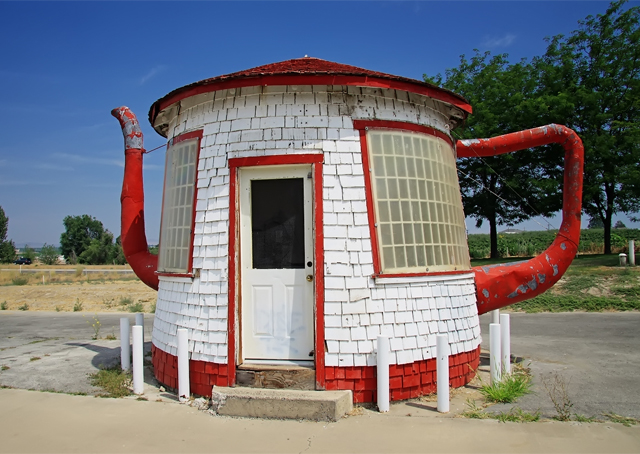
This simple edifice was built as a roadside attraction for Route 12 but soon deserved a spot in the U.S. National Register of Historic Places.
Originally conceived as an allusion to a political scandal during Warren G. Harding's presidency, now it is simply a moment in history made solid to make us smile in our travels.
Besides not needing to be grand, these types of buildings can also be abstract or allegorical to it's motif.
The building may only seem to be an object or action, like a boat or a flower.
Such is the case of Bilbao's Guggenheim Museum.
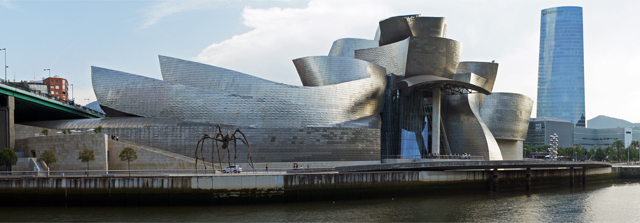
Conceived by the architect Frank Gehry as a Contemporary and Modern Art museum for the Solomon R. Guggenheim foundation, it rapidly grew into a global phenomenon of today's outstanding architecture.
A singular work that represents the fusion between technical and artistic development in its peak whilst also attracting thousands to gaze upon the complexity of shapes in conjuncture with the simplicity of the concept.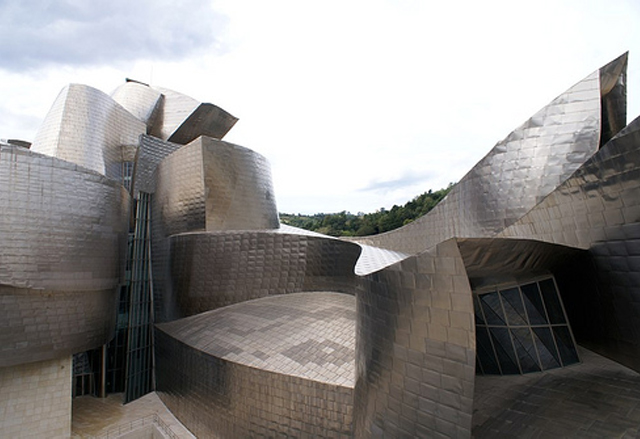
Gehry wanted the shapes seem etched at random, but all the while invoke the memories of a boat, if seen from the river, and of a flower, if seen from above.
Given these idealized images amongst the metallic shells one finds not one but two abstractions of objects which also show us two different times: the industrial past of Bilbao and its bright new future that this building itself brought upon it by revitalizing the city in its wake.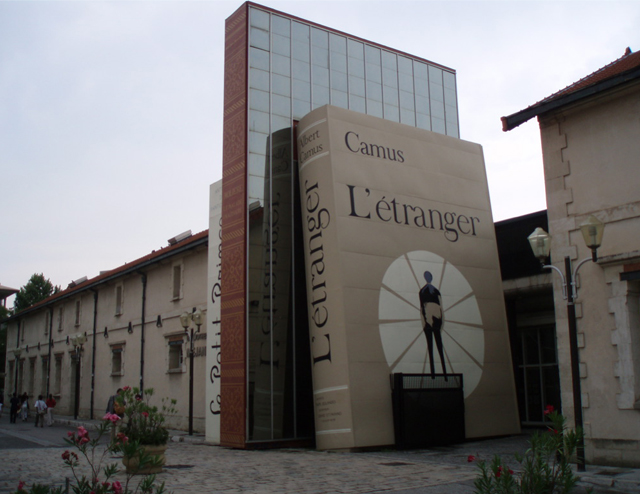
Now, not paying any attention to the shape, abstraction or scale of these objects made giant, but at the quantity, two examples come to mind, both libraries.
The 1989 facade of the Bibliothéque Méjanes in Aix en Provence, in France and the 2004 side wall of Kansas' Public Library, in the United States of America. Both examples of enlarged sets of books only legible as buildings.
Presenting us first with Le Petit Prince, a compilation of Moliere's writings and Albert Camus' L'Étranger, the peculiar library Méjanes captivates our curiosity with these three works.
Together as one, three slabs and an entrance are formed, and as such, an erected monument gravitates us towards the dreams encapsulated in the monolithic result of this composition.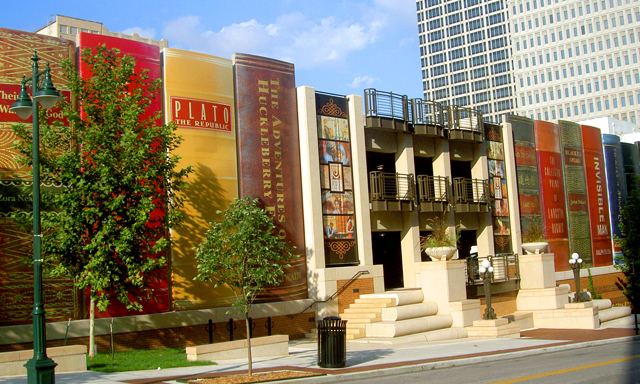
In an even more impressive arrangement, an example of an unbroken sequence of swollen books form a wall of memories that touched us, giving us the setting for the Kansas Public Library.
Listing the choices made for this framework of tales, we can find:
Two groups of seven and eight works, respectively, about the history and city of Kansas itself such as the Architectural History of Kansas, Nathan W. Pearson's Goin' to Kansas City, Evan S. Connell's Mrs. Bridge and some others;
A volume of the colossal community shelf that houses timeless child-themed stories like Dr. Seuss’ Green Eggs and Ham, the all-known Wonderful Wizard of Oz and six similar examples;
Besides the stories for the young ones or the ones from Kansas we have the classics from literature's history like Catch-22, Fahrenheit 451, Lao Tzu's Tao Te Ching, To Kill a Mocking Bird, the Invisible Man and more. This later group has a spectacular arrangement of 20 book spines solidifying our imagination in the city's landscape.
Quantity can also be made through some good contrasts, instead of repetition, and as an example we have the stunning Piano House, in Huainan from the Anhui province in China.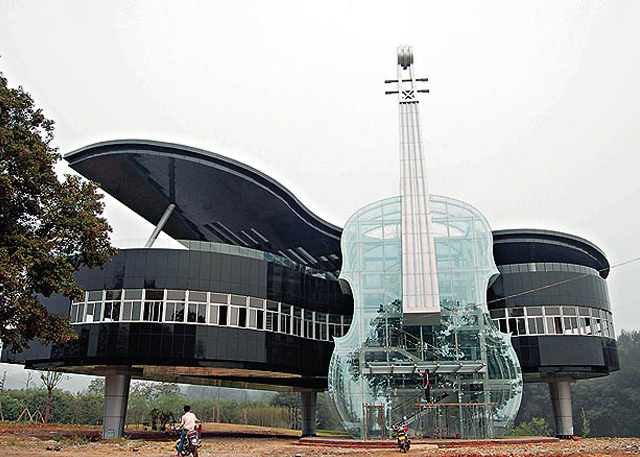
Made with the sole and simple purpose of attracting the maximum number of tourists possible for this almost tourist-barren region, the orders were cast to construct the house, now exhibition gallery, in the shape of a shining new piano and a translucid staircase in the shape of a glass violin.
Constructed in 2007, now a shade for the guests and showroom for the plans of the Shannan district, the building was designed by the Heifei University of Technology to be built at a perfect 50:1 scale, eventually winning over the fitting title of China's most romantic building.
Still in Asia, we find an example way less controversial than it sounds: the giant toilet of the World Toilet Association. Named Mr. Toilet House, the South Korean giant was built in 2007 as the house of Sim Jae-Duck, the former president of Suwon and the founder of the World Toilet Association.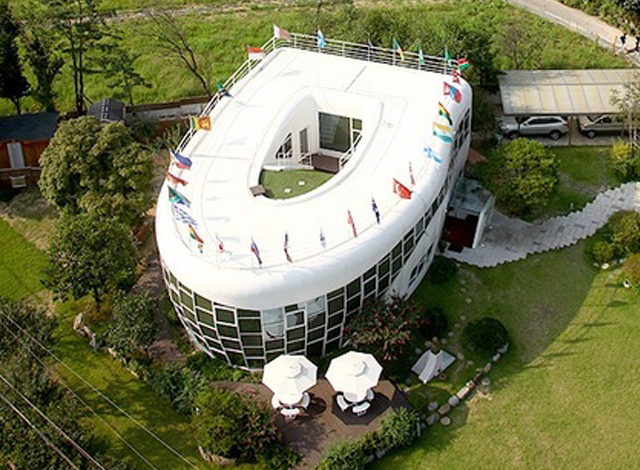
After his death in 2009 it was converted to a museum which opened in 2010 and is now homage to toilets and bathrooms in general.
Who visits this museum can see exhibitions on the history of bathrooms, showings of the most peculiar bathroom signs and, best of all, can just go the bathroom, the most privileged division at the heart and center of the building.
Having been adopted by Sim's family and converted to a museum, Mr. Toilet House has also now become the first and foremost component of a toilet-themed park, honoring the almost humorous culture of bathrooms worldwide.
Speaking of objects from our own dwellings, here we have a piece of furniture like no other: Furnitureland South’s giant chest of drawers.
The company, wanting to stand out as the world’s largest furniture store in the world, took the meaning of “largest store” quite literally.
Out of this self-parody came the impressive 25 meter high figure of the signature piece “Highboy”.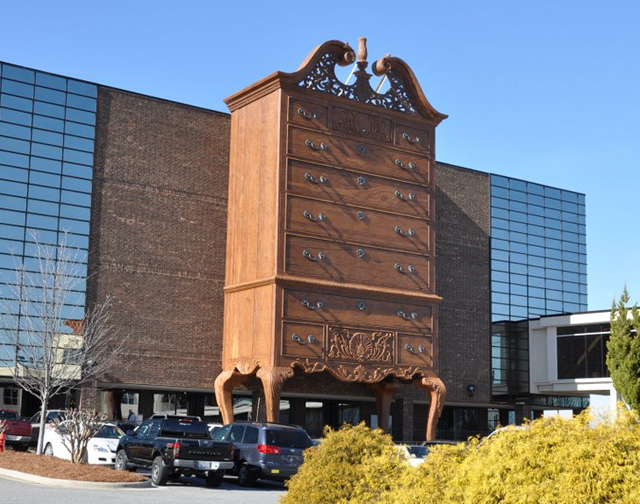
In 1999 Furnitureland South created the Mart building, crowned as the biggest eighteenth century chiffonier replica in the world and one of the most well-known spots in North Carolina.
Based on a metallic structure set in place after being covered for six weeks during the building process, the structure was shaped out of foam fastened to a pladur shell right then and there.
To keep the authenticity and rigor of the design, the technical drawings were printed to scale and were used in the construction site itself as a means of drawing on the foam and wood-like substances to cut them with electric saws manually.
Some parts, like the axis that separates the two bottom levels of drawers to the top ones, were sculpted by hand on the spot with brushes and sandpaper, and some parts, like the patterns on the top, were made back in the carpenter’s workshop and brought to the place.
The structure’s feet were made from big blocks of foam cut with a 1,5 meter long hotwire and the wooden texture of the entire building was painted on by brush strokes and paint rollers.
The last layer of varnish was placed upon by spray to give a fresh new look to the building and in 2008 that finishing was redone to look even more like the object and texture of origin.
To finish off with a treat, with a last example among so many others, we arrive at man’s best friend made even better: the Dog Bark Park Inn in Idaho, USA.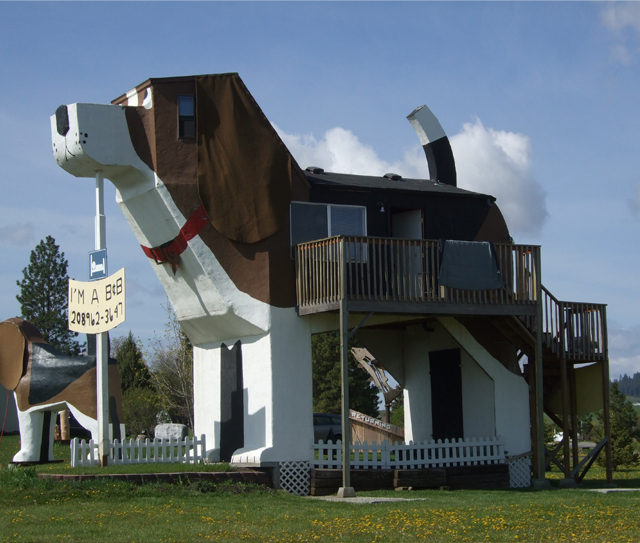
Artists since 1997, the couple of Dennis and Frances created the giant wooden dog from design to manufacture until they opened their doors in August, 2003.
The biggest beagle in the world became a place for comfort, a guest room, a breakfast house and a shelter for the wooden creations of the artists that cut, nailed and shaped all of this with their own two hands.
And since only two people created one of these world-class bits of fun, it makes us wonder how many others will follow? What else will be pumped up to become a fixture in our memories? 
The only thing that remains clear for now is: There already are so many big examples that keep on growing, keep on getting bigger. Bigger and better, always.